
Guide
How to find out if planning permission has been granted
The applicant gets a decision notice. In England, neighbours and objectors have no right to be told. Where a decision appears and how fast, what the council's wording actually means, and the deadlines that start whether or not you know.
By PlanIndex, published · last reviewed · 10 min read
The short answer
- In England a council must send its planning decision to the applicant (in practice usually their agent), tell a parish council or neighbourhood forum that was sent the application, and notify owners or agricultural tenants of the site who commented. Neighbours and other members of the public who commented have no right to be told.
- In Scotland the planning authority must inform everyone who made written representations, and gave an address, of the decision and where the notice can be inspected, under regulation 28 of the 2013 procedure regulations.
- In England a decision on a planning application must be entered on the council’s planning register within 14 days, under article 40(10) of the Development Management Procedure Order 2015. Prior approvals for house extensions and tree notices fall outside that rule, though councils usually list them on the same portal.
- Councils record decisions in their own words. In PlanIndex open data dated 8 November 2026, 207 councils used 981 distinct decision wordings, 515 of which PlanIndex reads as a grant. “Prior Approval Not Required” and “No Objection” both usually mean the work can go ahead.
- The six week limit for judicial review in England and Wales runs from the date permission is granted, not from when a neighbour finds out, and a committee resolution is not a grant until the decision notice is issued.
You commented on the application next door weeks ago, or walked past the site notice every morning, and nothing has come through the letterbox since. Or the application is your own and the eight weeks are nearly up. The answer will be on the council's register. What is not guaranteed is that anyone will bring it to you: in England the council must send the decision to the applicant and a short list of others, and a neighbour who objected is not on it.
This is written for England, with Scotland and Wales noted where they differ.
Who the council has to tell
The applicant gets a written decision notice, in practice usually sent to the agent who lodged the application. Articles 34 and 35 of the Town and Country Planning (Development Management Procedure) (England) Order 2015 require it and set what it must say: a full reason for every condition on a grant, and for a refusal, every reason and the development plan policies behind it, with a note on the right of appeal.
The same order adds a few narrow groups. A parish or town council, or a designated neighbourhood forum, that is sent applications in its area must be told the terms of each decision, under articles 25(3) and 25A. And under article 33(4), anyone who owns the site, or holds an agricultural tenancy on it, and commented after being served notice of the application must be sent the decision too.
Neighbours are not on that list, and nor are other members of the public who commented. The Local Government and Social Care Ombudsman said so plainly in a January 2025 decision about Gloucester City Council: a council is not required to notify objectors when planning decisions are made. The one exception is the small number of applications that need an environmental impact assessment, where regulation 30 of the 2017 EIA Regulations requires the council to publicise the decision. Otherwise, practice varies. Eastleigh tells people who comment that they will be told the final decision in writing, though for a petition only the first signatory is. Maidstone tells them it will not notify them at all. The council's "have your say" page says which kind yours is.
Wales works the same way: its 2012 procedure order has the same rule for owners and tenants of the site, in article 21(2), and nothing for neighbours. Scotland is the exception. Regulation 28 of the Development Management Procedure (Scotland) Regulations 2013 requires the planning authority to inform everyone who made written representations, and gave an address, of the decision and where the notice can be inspected.
So in England and Wales the person most affected by a decision next door is often the last to hear of it. That is the gap the Watch plan is for: for £5 a month it adds an email the day PlanIndex picks a decision up from the register, across three areas you choose, on top of the free daily digest of new applications.
Where a decision appears, and how quickly
Decisions on planning applications go on the planning register: article 40 of the procedure order requires the decision, any conditions and its date to be entered within 14 days. Prior approvals for house extensions and conservation area tree notices sit outside that rule (tree notices have their own register under section 214 of the 1990 Act), but councils usually list both on the same online portal, where a decision shows in three places.
The status changes from something like "pending consideration" to an outcome. A decision date appears; some portals also show the date the notice was issued, which is the one the deadlines below run from. And the decision notice joins the documents, usually with the officer's report, though when the report is published depends on whether an officer or a committee decided.
Some councils offer email updates on a single application; Malvern Hills' register has a sign up link on its application pages. Where yours does, it is the free way to follow a case you already know about.
Committee cases need one extra check. A committee vote to grant is a resolution, not a permission. Where it is subject to a section 106 agreement, the notice is issued only once the agreement is signed, which can take months. In R (Burkett) v Hammersmith and Fulham (2002) the House of Lords held that the time for a legal challenge runs from the grant, not the resolution; there the committee resolved on 15 September 1999 and permission was issued on 12 May 2000. Until the notice is issued, nothing has been granted, whatever the minutes say.
Reading the decision wording
Councils do not share a vocabulary for decisions. PlanIndex's open data dated 8 November 2026 holds 44,518 decided records from 207 councils with the decision wording exactly as each council published it. Set aside differences of capitalisation, punctuation and embedded dates, and that is still 981 distinct wordings. PlanIndex reads 515 of them as a grant and 172 as a refusal.
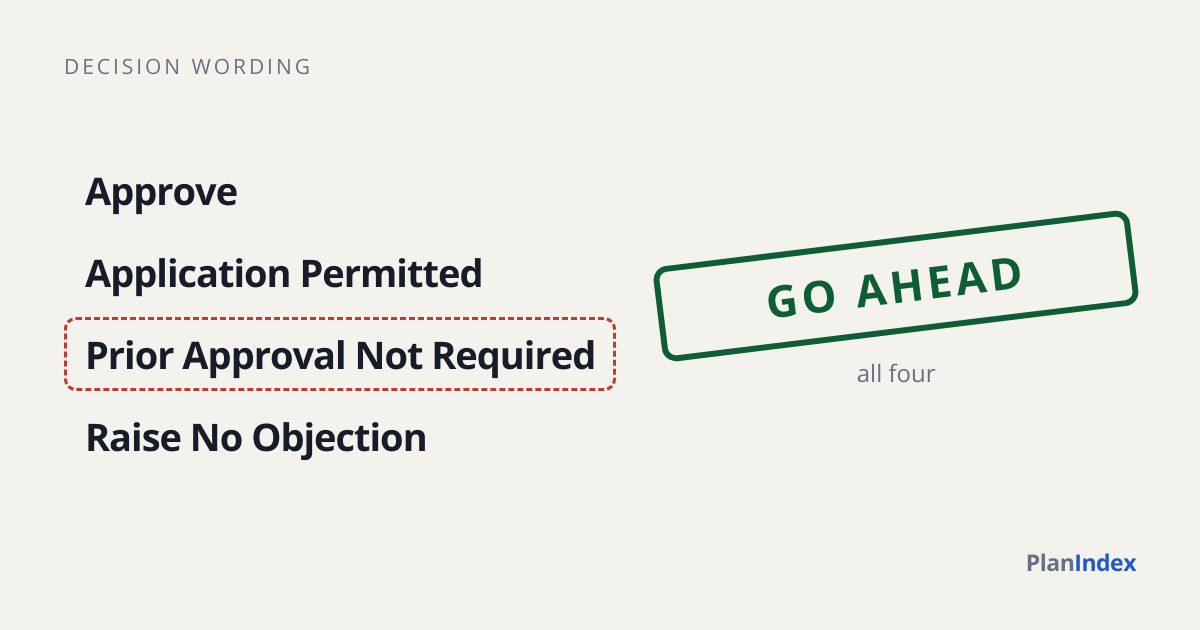
Most are plain: Approve, Application Permitted and Granted all mean permission was given. The trouble is a smaller set where the words seem to point away from the outcome, and two are common: some form of "Prior Approval Not Required" appears on 665 of those records at 71 councils, and "No Objection" on 1,622 at 83 councils, more than three quarters of them for tree work.
| Wording on the register | What it means |
|---|---|
| Prior Approval Not Required | The work can go ahead as described, provided it stays within the permitted development limits. For a larger rear extension it records that no adjoining neighbour objected |
| Prior Approval Required and Granted | The council assessed the matters the rules name and approved them, sometimes with conditions. For a larger rear extension it means a neighbour objected |
| No Objection, Raise No Objection | Usually a conservation area tree notice: no tree preservation order is being made, so the work can go ahead. Also used on telecoms notices |
| Permitted Development, Permission Not Required | Often a certificate of lawfulness granted, or confirmation that no application was needed |
| Split Decision | Part granted and part refused. The notice says which part |
| Withdrawn | Withdrawn before a decision. Nothing was granted, and a revised version often follows |
| Opinion Issued, Advice Given | Not a decision on an application: pre-application advice, a screening opinion or a reply to a notice |
| Decided, Finally Disposed Of | Closed, without saying which way. Open the decision notice |
"Finally disposed of" has a precise meaning. Under article 40(13) an application is finally disposed of once it has been decided and the time to appeal has passed with no appeal, or an appeal has been decided and the six weeks to challenge it have passed, or it was withdrawn. It tells you the file is closed, not what was decided.
Each application page on PlanIndex shows its reading of the outcome with the council's own words beneath it, marked "As published". The regimes behind the most misread wordings are covered in conservation area tree notices and prior approval for larger extensions.
Four extensions, four ways of saying it
Early in 2025 four councils decided prior approval applications for a larger single storey rear extension, the kind permitted development allows up to 6 metres deep, or 8 metres on a detached house, once the council has been asked first. Their registers record the outcomes like this.
| Council and reference | Wording as published | Received | Decided | Can it be built? |
|---|---|---|---|---|
| Cambridge, 25/00013/PRIOR | Prior Approval Not Required | 3 January 2025 | 31 January 2025 | Yes |
| Basildon, 25/00070/PDPA | Prior Approval Not Required | 21 January 2025 | 21 February 2025 | Yes |
| Birmingham, 2024/08031/PA | PRIOR APPROVAL REQUIRED AND TO APPROVE WITH CONDITIONS | 19 December 2024 | 31 January 2025 | Yes, subject to conditions |
| Brent, 25/0284 | Prior approval is refused at submission | 30 January 2025 | 31 January 2025 | Not under this application |
Three can be built, and only one of the three says it is approved. Under paragraph A.4(7) of Class A in the General Permitted Development Order, prior approval is only required if an adjoining owner or occupier objects, so "not required" records that nobody did, the cleanest result an applicant can get. Birmingham's wording records the other path: an objection, an assessment and an approval with conditions. Brent's records a refusal at the first check. Its decision notice says the form did not list every adjoining address, which paragraph A.4(2) requires, so the council refused it under paragraph A.4(3) without writing to any neighbour and without assessing whether the extension was permitted development at all.
The Brent address shows why the site history matters as much as the latest line. Eighteen days earlier the same house had a prior approval application for a 6 metre rear extension, 24/3536, recorded on 13 January 2025 as "Prior approval is not required". The refusal of the second application took nothing away from the first.
The deadlines a decision starts
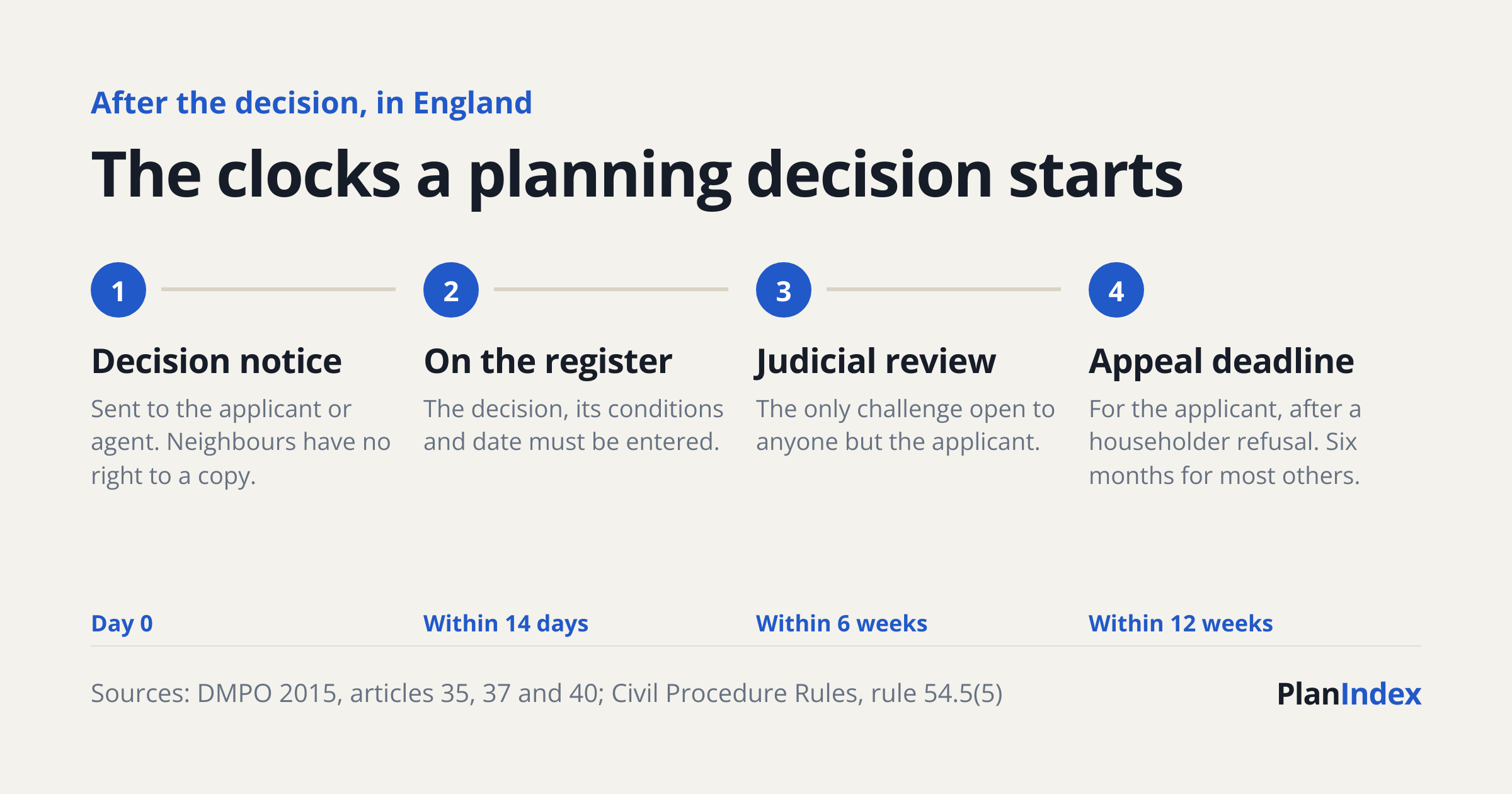
A decision starts several clocks at once, and none of them waits for you to hear about it.
Sources: Development Management Procedure (England) Order 2015, articles 35, 37 and 40; Civil Procedure Rules, rule 54.5(5)
For a planning application, the register entry is due within 14 days. The applicant's deadline to appeal a refusal runs from the date of the notice: 12 weeks for a householder or minor commercial application and six months for most others, as what follows a refusal explains. If a householder applicant does appeal, regulation 6 of the 2009 written representations regulations requires the council to write to everyone who was notified of the application or commented on it, within five working days of the appeal starting. That is the oddity of the English system: you have a right to hear about an appeal against a refusal, and none to hear about the grant itself.
For anyone else, the only challenge to a council's grant is judicial review. In England and Wales the claim must be filed within six weeks, under rule 54.5(5) of the Civil Procedure Rules, and in Scotland within three months, under section 27A of the Court of Session Act 1988. It tests whether the decision was lawfully made, not whether it was right, and in practice needs a solicitor from the first day. The clock starts on the grant, so a neighbour who learns of a decision five weeks late has days left, not weeks. What a neighbour can do after a grant covers conditions and enforcement.
For an applicant with a grant, pre-commencement conditions have to be discharged before work begins, and those applications reach the register without a letter to anyone.
Where this guide stops
The 14 day rule is a duty, not a description of every council's performance. PlanIndex reads each council's published register, so a decision reaches a PlanIndex alert only once the council has put it online. Coverage is the councils in the council directory, and a council being listed does not mean its history is complete.
The wording table is a guide to common usage. The decision notice is the legal record, and where the two disagree, the notice wins. Northern Ireland runs its own procedure and is not covered here. None of this is legal advice.
Keeping track
To look up a decision now, open the council in the list of councils and search by reference or address; when a search comes up empty covers the usual formatting traps. To hear about decisions on a street, including ones you never knew had been applied for, watch an area free for new applications and add the Watch plan for the email the day a decision lands. Firms that act on approvals get the same alert across a patch of up to five miles on the Trade plan.
Sources
Where the facts above come from
Common questions
Will I be told if my neighbour's planning application is approved?
Not necessarily. In England and Wales a council has no duty to tell neighbours or objectors about a decision, and practice varies: some write to everyone who commented, others say plainly that they will not. In Scotland the council must tell everyone who made written representations. The decision goes on the council’s register, and in England a decision on a planning application must be entered within 14 days.
What does prior approval not required mean?
It means the work can go ahead as described in the application, provided it stays within the permitted development limits. For a larger rear extension, the council only has to assess the effect on neighbours if an adjoining owner or occupier objects, so “prior approval not required” usually records that nobody did. It is effectively a yes, not a refusal.
How long after a planning decision does it appear online?
In England a decision on a planning application must be entered on the planning register within 14 days of being made. Many councils update their online register sooner and add the decision notice and officer’s report to the documents, but timing varies from council to council.
What does finally disposed of mean on a planning application?
It means the file is closed. The application has been decided and the time to appeal has passed without an appeal, or an appeal has been decided and its own challenge period has passed, or the application was withdrawn. It does not say whether permission was granted, so open the decision notice to find out.
Can I challenge a planning decision if I only find out about it late?
Only by judicial review, which in England and Wales must be filed within six weeks of the grant and in Scotland within three months. The clock starts when permission is granted, not when you learn of it, so finding out late can mean little or no time remains, and courts rarely allow longer. Take legal advice straight away.