
Guide
When you need permission to cut down or prune a tree
Most garden trees can be felled or pruned without asking anyone. A tree preservation order or a conservation area changes that. How to check, what needs consent and what only needs six weeks' notice, the exceptions, and the penalties.
By PlanIndex, published · last reviewed · 13 min read
The short answer
- In England most garden trees can be felled or pruned without asking anyone. The exceptions are a tree protected by a tree preservation order, a tree in a conservation area, and a tree protected by a condition on a planning permission.
- Work to a tree under a tree preservation order needs the council's written consent. There is no fee, the council has eight weeks to decide, and consent normally lasts two years and covers the work once.
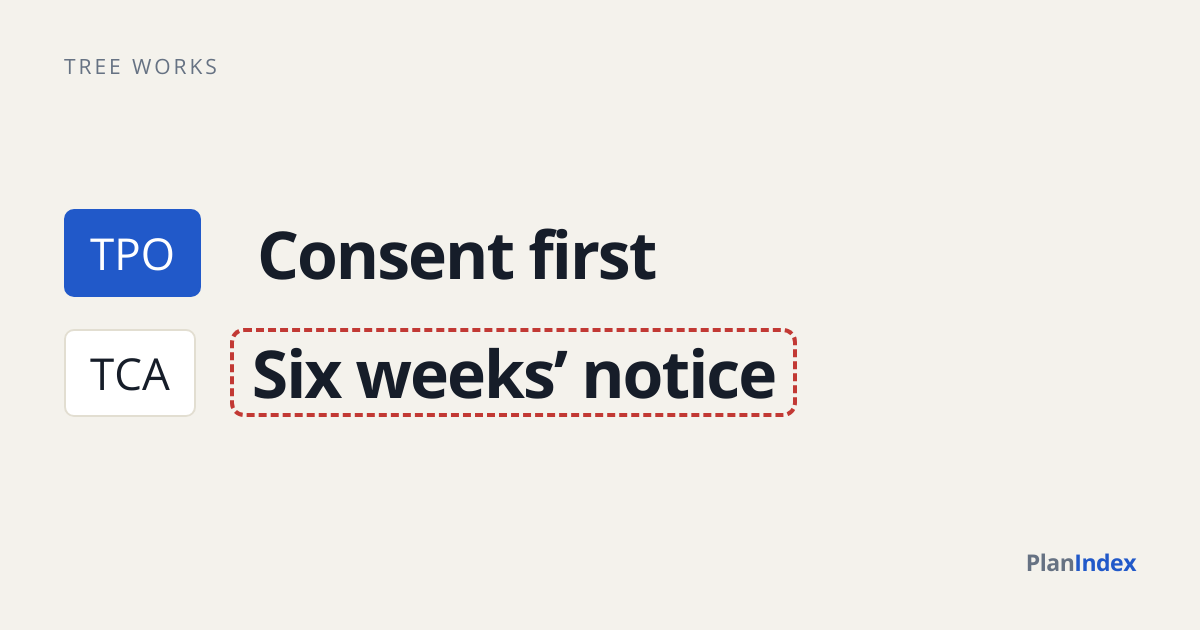
- In a conservation area, cutting down or pruning a tree with a trunk more than 75mm across at 1.5 metres needs six weeks' notice to the council. A notice is not an application: the council can only stop the work by making a tree preservation order.
- A dead tree under an order can be felled without consent, but the council must normally have five working days' written notice first, and the owner normally has to plant a replacement.
- Felling a protected tree without consent is an offence carrying an unlimited fine, for whoever does the work and whoever causes or permits it, and the landowner normally has to plant a replacement.
A tree has outgrown the garden or crept too close to the house, and the question is whether anyone has to be asked before it is cut back or felled. Sometimes it is the other way round: the tree is next door, and a notice about it has appeared on the council's register. For most garden trees in England nobody has to be asked. Two things usually change that: a tree preservation order on the tree, or a conservation area around it. The first needs the council's consent. The second only needs the council to be told, six weeks ahead, and the difference decides what the council can do about it. Everything here is England's system unless the text says otherwise.
Consent or notice: the two kinds of protection
A tree preservation order is made by the council to protect specific trees in the interests of amenity. It can cover individual trees, trees within an area, groups of trees or whole woodlands. Once an order is in force, nobody may cut down, top, lop, uproot, wilfully damage or wilfully destroy a protected tree without the council's written consent, and the government's view is that cutting its roots needs consent too.
A conservation area protects the trees in it more lightly. Anyone planning the same kinds of work to a tree there must give the council six weeks' notice, under section 211 of the Town and Country Planning Act 1990. A notice is not an application. The council cannot refuse it or attach conditions, and the only way it can stop the work is to make a tree preservation order. A tree in a conservation area that already has an order follows the order's rules.
| Tree preservation order | Conservation area, no order | |
|---|---|---|
| What you send | An application for consent | A notice of the intended work |
| Fee | None | None |
| How long the council has | Eight weeks, after which the applicant can appeal | Six weeks, after which the work can go ahead if no order has been made |
| What the council can do | Grant consent, with or without conditions, or refuse | Make an order, or let the work proceed |
| How long the answer lasts | Two years from the grant, for one round of work, unless a condition says otherwise | Two years from the date of the notice |
| If you disagree | Appeal to the Planning Inspectorate within 28 days of receiving the decision | Object to the new order, within the period it gives of at least 28 days |
Checking whether a tree is protected
Ask the council. Every confirmed order has to be available for inspection at the council's offices, and many councils publish a map of protected trees and conservation areas online. A confirmed order is also recorded as a charge on the land, so it shows up in the local authority search a buyer's solicitor orders.
The government's planning data platform maps conservation areas and tree preservation zones for the councils that supply them, but its own pages warn that the data may be incomplete and may not yet cover all of England. A tree that does not appear there is unknown, not unprotected.
The planning register is the other place to look, because earlier tree work at the same address often quotes the order. Chichester's 26/01803/TPA, for work to an ash at Coachmans in St Andrews Lane, Tangmere, identifies the tree by its number under order TG/98/01030/TPO. Search the address; our guide to searching a council's register covers the quirks.
Two details catch people out. An order covering an area protects only the trees standing when it was made, while a woodland order also protects trees that grow up afterwards. And an order takes effect the day it is made: it runs provisionally for six months, the owner and occupiers are sent a copy with at least 28 days to object, and the council must confirm it within the six months or it lapses.
Dead, dangerous and small trees, and other exceptions
The exceptions are set out in regulation 14 of the Town and Country Planning (Tree Preservation) (England) Regulations 2012, and regulation 15 applies them to conservation areas. The ones a householder is most likely to rely on:
- A dead tree. It can be cut down without consent, but the council must have written notice at least five working days beforehand. If it is also an immediate danger, the next exception applies instead. Dead branches can be taken off a living tree with no notice at all. The exception is for a tree that is dead: a dying or diseased tree still needs consent or notice in the usual way.
- An immediate risk of serious harm. Only the work urgently needed to remove the risk is covered, and written notice must reach the council as soon as practicable after it became necessary.
- A small tree in a conservation area. No notice is needed to fell or prune a tree whose trunk is 75mm or less in diameter, measured over the bark 1.5 metres above the ground, or 100mm or less if it is being felled solely to help other trees grow. On a multi-stemmed tree, one stem over the limit brings the whole tree in. This size exception applies in conservation areas only, not to a tree under an order.
- Work needed to carry out a full planning permission. An outline permission does not count, and nor does permitted development.
- Fruit trees, pruned in line with good horticultural practice, or worked on in the course of a fruit growing business.
- A legal nuisance. The minimum work needed to stop a nuisance in its legal sense, which the courts have held means the tree is causing actual damage or there is an immediate risk that it will.
Felling a tree under either of the first two exceptions still leaves the owner with a duty to plant a replacement of an appropriate size and species in the same place, unless the tree was protected as part of a woodland or the council waives the duty. Anyone relying on an exception may later have to show that it applied. Photographs taken before the work starts are the obvious evidence.
Applying for consent under an order
The application goes to the council on the standard tree works form, online through the Planning Portal or on paper, and there is no fee. It needs a plan identifying each tree, the work proposed and the reasons for it. Where the reason is the tree's health or safety, or damage it is causing, the evidence has to come with it. A subsidence claim has to show the tree is a material cause and that other causes have been ruled out as far as possible, and a claim about a garden wall, drain or drive needs technical evidence from an engineer, surveyor or other appropriate expert. The council cannot insist on more than the standard form asks for.
The council weighs the tree's amenity value, and what the work would do to it, against the reasons given. Government guidance says the higher the amenity value, the stronger the reasons need to be. If the council wants a replacement planted, it has to say so in a condition. A consent lasts two years from the date it is granted and covers the work once, unless a condition says otherwise.
Chichester's 26/01803/TPA shows the usual shape. The application to reduce the Tangmere ash by three metres, back to its previous pruning points, was received on 17 August 2026 and permitted under delegated powers on 22 September, 36 days later. Unless the decision notice sets a different period, the owner has two years from 22 September 2026 to have the work done. Tree cases are among the quicker things a council decides: across the decisions behind PlanIndex's decision times by application type, the median for tree work was 38 days when this guide was checked, against 56 days for all application types.
If consent is refused, or granted with conditions the applicant cannot accept, the applicant can appeal to the Planning Inspectorate within 28 days of receiving the decision. If no decision arrives within eight weeks, an appeal can be made at any point after that, unless a late decision arrives first, in which case the 28 days run from receiving it. Where a refusal or a condition causes loss or damage, the council can be liable for compensation, but the claim must be made within 12 months and be for at least £500, and it does not cover loss of development value or any other fall in the value of the land.
Giving notice in a conservation area
The standard tree works form has a version for conservation area notices, but a notice does not have to be on any particular form. It has to describe the work, identify the tree and give its date, and a plan is optional. There is no fee. The council must keep a register of these notices, available for inspection free of charge.
The council then has three choices. It can make a tree preservation order, preferably within the six weeks. It can tell you it will not make one, and the work can start straight away. Or it can let the six weeks pass, after which the work can be done at any time up to two years from the date of the notice. After two years, a fresh notice is needed.
The wording on registers varies. Chichester's 26/01823/TCA, a notice received on 18 August 2026 to reduce a Monterey cypress at 5 St Johns Street by up to half its height, ran a neighbour consultation until 15 September and was decided the next day as "not to prepare a tree preservation order". North Hertfordshire recorded 26/02377/TCA, a notice to remove three Lawson cypress at 1 Burge End Lane in Pirton, as "no objection" on 16 October, 24 days after it arrived. Different words, the same result: no order, so the work can go ahead. Registers word decisions in hundreds of different ways, and reading the decision wording covers the ones most often misread. Whatever status a register shows, the law runs on the dates. Unless the council has made an order, which protects the tree from the day it is made, the work can go ahead once six weeks have passed, up to two years from the date of the notice.
When the tree belongs to a neighbour
You can cut back branches and roots that cross onto your land, up to the boundary and no further. Go beyond it and the neighbour could take you to court for damaging their property. If the tree is under an order or in a conservation area, the consent or notice rules apply to you just as they would to the owner.
If your neighbour wants to fell or cut back a protected tree, the application or notice goes on a register the council must keep open to the public, and in practice that is usually the same online register as planning applications. Comments go to the council. The general advice on writing a comment the council can use holds, but the test is narrower than for a planning application: the tree's amenity value against the reasons for the work. For a conservation area notice, the only result that stops the work is a new order, so explain why the tree matters to the area, and do it well inside the six weeks.
An unprotected garden tree outside a conservation area, with no planning condition protecting it, is the owner's to fell.
What happens if the rules are broken
Cutting down, uprooting or wilfully destroying a protected tree, or damaging, topping or lopping it in a way likely to destroy it, is an offence under section 210 of the 1990 Act, punishable by an unlimited fine. In setting the fine the court must take into account any financial benefit the offender gained or was likely to gain. Lesser breaches, such as lopping that is not likely to destroy the tree, carry a fine of up to level 4 on the standard scale, currently £2,500. Work to a conservation area tree without notice carries the same penalties.
The offence reaches whoever does the work and whoever causes or permits it, so the owner who books the job and the tree surgeon who carries it out are both exposed. Where a protected tree has been removed, uprooted or destroyed, the owner must also plant a replacement of an appropriate size and species in the same place as soon as reasonably possible, unless the council agrees to waive it. That duty passes to whoever owns the land later, and the council can enforce it with a tree replacement notice.
Other permissions that can apply
A felling licence from the Forestry Commission is needed to fell more than five cubic metres of timber in a calendar quarter, or to sell more than two cubic metres of it, but trees in private gardens, orchards and churchyards are exempt, as are trees with trunks under 8cm across at chest height. For most householders it never arises. It matters on larger grounds, paddocks and woodland.
A planning permission can carry conditions about trees, requiring some to be kept or new ones planted, and those conditions bind later owners. The decision notice for the property sets them out, and what a planning condition means covers how to find and read one.
Wildlife law applies whatever the planning position. Consent under an order, or an exception, does not override the protection given to wildlife such as nesting birds and bats, and the government's guidance points anyone unsure to the council or Natural England.
Where this guide stops
This is England's system. Wales currently uses the same section 211 notice under the 1990 Act, with its own regulations, and in Scotland section 172 of the Town and Country Planning (Scotland) Act 1997 also sets six weeks' notice and a two year window for conservation area trees. Northern Ireland runs a separate system. Hedges are a different matter: an order would not normally include shrubs, though trees growing in a hedge can be protected, and countryside hedgerows have their own legislation. None of this is legal advice, and where an order, a subsidence claim or a development site is involved, talk to the council's tree officer before anyone picks up a saw.
Keeping track
Tree work is one of the commonest things on a planning register: PlanIndex indexed 71,231 tree applications and notices in the twelve months to October 2026. They are filed under codes such as TPA, TPO and TCA, which the reference number guide decodes, and planning application types explained sets them against everything else on the register.
Each council's page in the planning applications directory lists them with the rest. An alert for your area sends new ones by email, so a notice about a tree you can see from your window reaches you inside its six weeks rather than after them. If you quote for tree work, the tree surgeons' page shows what a patch produces.
Sources
Where the facts above come from
Common questions
Can I cut back branches from my neighbour's tree?
Yes, up to your boundary. You can trim branches and roots that cross onto your land, but cutting beyond the boundary could lead to a claim for damaging their property. If the tree is protected by a tree preservation order or stands in a conservation area, you need the council's consent, or must give six weeks' notice, before cutting, exactly as the owner would.
How do I find out if a tree has a tree preservation order?
Ask the council: every confirmed order must be available for inspection at its offices, and many councils publish a map of protected trees online. A confirmed order is also recorded as a local land charge, so it appears in the local authority search when a property is bought. Earlier applications for tree work at the same address on the planning register usually quote the order's reference.
Is there a fee for a tree preservation order application?
No. In England there is no fee for an application to carry out work to a tree under a tree preservation order, or for a notice of work to a tree in a conservation area. Both can be made on the standard tree works form, online through the Planning Portal or direct to the council.
Do I need permission to cut down a dead tree?
Not if the tree is unprotected. If it is under a tree preservation order you do not need consent, but the council must have written notice at least five working days before the work, unless the work is urgently needed to remove an immediate risk of serious harm, when notice must follow as soon as practicable. The owner must then normally plant a replacement of an appropriate size and species in the same place. Dead branches can be removed from a living tree with no notice, but a tree that is dying or diseased and still alive needs consent or notice in the usual way.
What happens if you cut down a protected tree without permission?
It is a criminal offence under section 210 of the Town and Country Planning Act 1990, punishable by an unlimited fine, and the court must take into account any financial benefit gained. The person who did the work and anyone who caused or permitted it can both be prosecuted. The landowner also normally has to plant a replacement tree of an appropriate size and species in the same place, a duty that passes to later owners.