
Guide
How to read an officer's report
The officer's report is the only place a council explains a planning decision. Which section to read first, what "on balance" and "limited weight" mean, when it is published for delegated and committee cases, and what you can do if your objection is missing.
By PlanIndex, published · last reviewed · 12 min read
The short answer
- An officer's report is the council's written reasoning for a planning decision: it names the issues, weighs them against policy and recommends approval or refusal. For a grant it is usually the only written explanation there is.
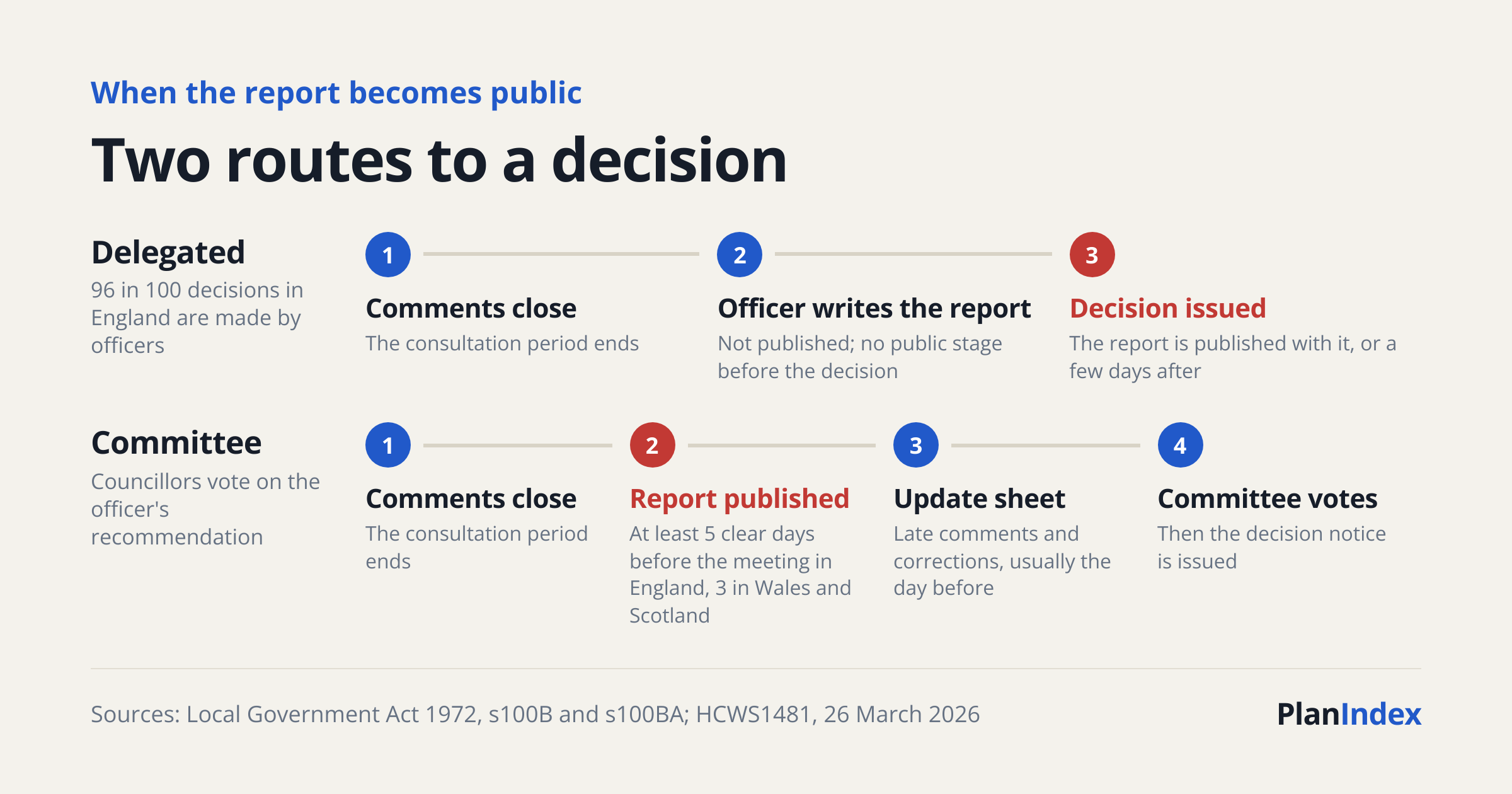
- In England, 96 per cent of decisions are made by officers under delegated powers, so the report is normally published with the decision rather than before it, and cannot be corrected first.
- A report going to committee must be open to the public at least five clear days before the meeting in England, and three in Wales and Scotland. That is the window to point out an error or a missing objection.
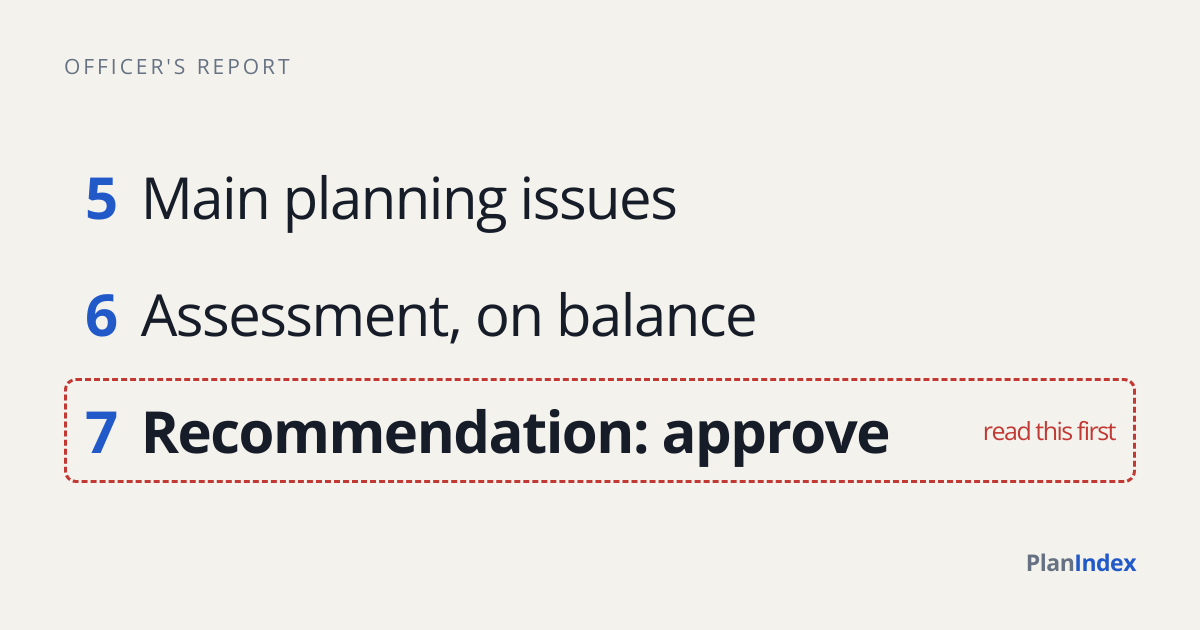
- Read the recommendation first, then the officer's list of main issues and the assessment under each. "On balance" marks the point where a policy conflict was found and outweighed.
- From 31 October 2026, householder and other minor applications in England must be decided by officers, so the delegated report becomes the whole of the council's explanation for nearly all of them.
The decision has arrived, and underneath it sits a document most people never open. The officer's report is where the council explains itself: what it thought the application turned on, what the objections amounted to, which policies applied and why the answer came out the way it did. If you objected, it is the only place you will find out whether your points were read. If you applied and were refused, it is the case you will have to answer at appeal. If the application is heading to committee, it is the councillors' brief, published before they vote.
Two kinds of report, one shape
Every application gets a case officer, and the case officer writes a report. What happens to it next depends on who decides. In England, 96 per cent of decisions are not made by planning committees at all: they are taken by officers under delegated powers, and the report is written to justify the officer's own decision. That is a delegated report. The rest go to a committee of councillors, and the report becomes a recommendation for them to accept or reject.
The two look alike because they do the same job. Both describe the site and the proposal, list the planning history, summarise consultee replies and public comments, set out the policies, assess the issues and end with a recommendation. A committee report tends to be longer, opens with the reason the case is at committee rather than delegated, and is often followed by an update sheet or addendum covering anything that arrived after it was written.
Scotland gives the document a statutory name. The report of handling must be placed on the register for every application, alongside the decision notice. Wales follows the English pattern. In Northern Ireland the councils call it a development management officer report.
The courts have said how these reports should be read. In Mansell v Tonbridge and Malling Borough Council (2017), the Court of Appeal said officer reports are written for councillors who know their area, should be read as a whole and with reasonable benevolence, and should not be picked apart for slips. That cuts both ways for a reader. An unfortunate phrase will not sink the decision, and the report is advice from a professional planner rather than a legal ruling: the officer's view on weight is theirs, and a committee, an inspector or a court can take a different one.
When you can see it
The timing is the part that catches people out, and it differs by route.
A delegated report is normally published with the decision. Many councils upload it to the application record on the day the decision notice is issued; some take a few days; a minority publish only a short decision summary and hold the full report on file. In England the report is also the written record, with reasons, that regulation 7 of the Openness of Local Government Bodies Regulations 2014 requires an officer to produce when a delegated decision grants a permission, and to make available for public inspection, so a council that publishes only a summary still holds the full report and can be asked for it. Either way, nobody outside the council reads it before the decision is made, so there is no stage at which an objector can point out that it has missed something.
A committee report is public before the vote. In England, section 100B of the Local Government Act 1972 requires the agenda and reports for a council meeting to be open to public inspection at least five clear days before it, and clear days do not include the day of publication or the day of the meeting. In Wales the figure is three clear days, published electronically, under section 100BA. Scotland's councils also work to three. The council's committee pages list the meeting dates, and the report appears in the agenda pack there before it reaches the application record.
Sources: Local Government Act 1972, sections 100B and 100BA; written statement HCWS1481, 26 March 2026
From 31 October 2026 the route is fixed by regulation in England. The Town and Country Planning (Discharge of Local Planning Authority Functions) (England) Regulations 2026 bring in a national scheme of delegation. Schedule 1 lists the applications that must be decided by officers: householder applications, minor commercial development, minor residential schemes of up to nine homes on sites under half a hectare, most reserved matters approvals, discharge of conditions, prior approvals, certificates of lawfulness and permission in principle. Everything else sits in Schedule 2, where the presumption is still delegation, and referral to committee needs a statutory gateway test to be met and the council's nominated officer and nominated committee member to agree. The statutory guidance says plainly that objection counts and ward councillor call-ins will no longer be a route to committee. For an extension next door, the delegated report is now the whole of the council's explanation.
Read it in this order
A report is written front to back, but it is best read in the order that tells you what you need.
- The recommendation, which is at the end. Approve subject to conditions, refuse for the following reasons, or, at committee, delegate to officers to approve once a legal agreement is signed.
- The main issues. Most reports have a short paragraph or list naming what the officer thought the case turned on. If your concern is not on it, the report is unlikely to deal with it in any depth.
- The assessment, one heading per issue. This is the only part with reasoning in it.
- Representations, where public comments are summarised. Check that your point is there, and that it is your point rather than a paraphrase that is easier to answer.
- The conditions, each with a reason. Where an objection has changed the scheme without stopping it, this is where the change lives.
Then the rest, which is context.
| Section | What it holds | What to look for |
|---|---|---|
| Site and proposal | The site as the officer found it, and the scheme as drawn | Whether the description matches the current drawings; schemes are amended mid-application |
| Planning history | Earlier applications and decisions on the site | A refusal the current scheme is designed to answer, or a permission that gives the applicant a fallback |
| Consultations | Replies from the highway authority, environmental health, the parish council and others | No objection subject to conditions, which is where many conditions originate |
| Representations | Public comments, grouped and counted | Whether your point is stated and answered, or listed and left |
| Policy | The development plan policies and national policy the officer applied | The policy codes, which are what an objection or appeal has to cite |
| Assessment | The officer's reasoning under each main issue | The words that carry weight, covered below |
| Planning balance | Harms set against benefits | "On balance", and which side the deciding weight fell on |
| Recommendation and conditions | The proposed decision, with numbered conditions and reasons | Pre-commencement conditions, and any condition removing permitted development rights |
| Informatives | Advice to the applicant that is not a condition | Nothing enforceable; do not mistake one for a safeguard |
The words that carry the decision
Reports are written in a narrow dialect, and a few terms do most of the work.
The legal starting point is section 38(6) of the Planning and Compulsory Purchase Act 2004: an application must be decided in accordance with the development plan unless material considerations indicate otherwise. So a report first asks whether the scheme accords with the plan, then whether anything material points the other way. Material considerations are the matters the officer is allowed to weigh, and a comment about property values or the applicant's motives will be listed in the representations and not mentioned again.
Weight is the currency. A consideration is given no weight, limited weight, moderate weight, significant weight or substantial weight, and the assessment is a ledger of those entries. "On balance" is the phrase that marks the sum being done, and it usually means the officer found a conflict with something and decided it was outweighed. "It is considered that" and "it is not considered that" introduce the officer's own judgement, as opposed to a fact about the site. Where a listed building or conservation area is involved, "less than substantial harm" is a term of art from national policy rather than a reassurance, and it still has to be weighed against public benefits.
A fallback is what the applicant could build without asking. If a slightly smaller version of the scheme would be permitted development, the officer can treat that as a real prospect and compare the application against it rather than against an empty site.
Policy citations date the report. Reports written before 17 August 2026 cite the National Planning Policy Framework by paragraph or chapter; the Framework published that day is organised as numbered plan-making and decision-making policies instead, so a report may quote either depending on when it was drafted. Local plan policies are cited by code, and those codes are what you would use in an objection or an appeal.
A delegated report, read
Hillingdon's delegated householder decision on 75975/APP/2026/306, issued in April 2026, is nine pages long and shows the shape in miniature. The application was retrospective: an outbuilding already built in the rear garden of a mid-terrace house in West Drayton, 2.65 metres high, which needed permission because it was taller than the 2.5 metres allowed under permitted development. Six neighbours were written to and none replied.
The officer's list of main issues was four items long: character and appearance, neighbour amenity, flood risk and the loss of garden. The policy section quoted a paragraph of the local plan which says an outbuilding should, as a general guide, be no more than 30 square metres. This one was 37.6. The assessment did not hide that. It said the building was "not technically compliant" with that paragraph, then set three things against it: similar outbuildings nearby, a fallback in the form of a 2.5 metre version that would have needed no permission at all, and floor plans, confirmed on a site visit, showing no bedroom or kitchen. The conclusion recommended approval "on balance", with a condition restricting the building to incidental use so it could never become a separate home.
That is the whole method in one case. A conflict with policy is found, weighed and outweighed; the fallback does real work; and the neighbours' protection ends up in a condition rather than a refusal. It also shows the limit of the exercise. Nobody objected, so the representations section had nothing to weigh, and the report was public only once the decision had been made.
If your objection is not in there
For a committee case, the clear days exist for exactly this. Email the case officer, quote the application reference, and say precisely what is missing or misstated; corrections go into the update sheet the committee receives. Send the same note to the committee members, whose addresses are on the council's website, and register to speak if the council allows it. How committee works is covered in the objection guide. If the committee then grants permission against the officer's advice, the Supreme Court in Dover District Council v CPRE Kent (2017) said that in cases of that kind the reasons have to be given, so the minutes should record why the members disagreed.
For a delegated case there is no stage before the decision, and afterwards the options are narrow. There is no third party appeal against a grant anywhere in the UK. A report that summarised your objection briefly, or grouped it with others, has not done anything wrong: the courts do not require a report to answer every point at length. Only a defect that could have changed the decision, such as a material consideration ignored entirely or a policy misread, is a ground for legal challenge, and that is a judicial review on strict time limits with a solicitor from the start.
If you are the applicant and the recommendation was refusal, the report is the council's case. The reasons on the decision notice are short; the paragraphs in the report behind each reason are what an appeal has to answer, and what follows a refusal sets out the routes.
Where this guide stops
Not every application produces a report worth the name. Non-material amendments, some prior approvals and some discharge of conditions applications get a few lines or a form. Councils also differ in what they publish online, and the written record that must exist is not always the document that appears on the portal. The timings above are statutory minimums, and a council's own constitution sometimes gives longer.
PlanIndex holds the register entry, the dates and the decision, and each application links to the council's own record, which is where the report lives. This site does not host the reports themselves.
Finding the report for a case near you
Search the council's applications, open the case, and follow the link to the council record; the report is usually filed under documents, dated the day of the decision or the committee. The reference number tells you the application type before you open anything. To catch the next case while the comment window is still open, rather than after the report has been written, set up an alert for your street.
Sources
Where the facts above come from
Common questions
Can I see the officer's report before the planning decision is made?
Only if the application is going to committee. In England the report must be open to public inspection at least five clear days before the meeting, and three clear days in Wales and Scotland; it appears in the agenda pack on the council's committee pages. For a delegated decision, which is 96 per cent of decisions in England, the report is published with the decision notice or shortly after it, and there is no earlier stage at which the public can read or respond to it.
What does "on balance" mean in a planning officer's report?
It marks the point where the officer has set the harms of a scheme against its benefits and reached a conclusion, and it usually signals that a conflict with a policy or guideline was found and judged to be outweighed. A recommendation made "on balance" is a judgement rather than a finding of compliance, which is why a committee, an inspector or a court can weigh the same considerations differently.
My objection is not mentioned in the report. What can I do?
If the case is going to committee, email the case officer with the application reference before the meeting and say exactly what is missing or misstated; corrections go into the update sheet members receive. Write to the committee members as well, and register to speak if the council allows it. If the decision was delegated, the report was published after the decision and cannot be corrected. There is no third party appeal, and a brief or grouped summary of an objection is not a legal defect; only an error that could have changed the outcome is a ground for judicial review.
Does the officer's recommendation decide the outcome?
For a delegated decision, yes: the officer who writes the report, or a senior officer who signs it off, makes the decision. At committee the recommendation is advice, and councillors can and do vote against it, though they must give planning reasons for doing so. Where a committee grants permission against the officer's advice, the Supreme Court has said the reasons must be recorded, so the minutes should explain the departure.
What is a report of handling?
The Scottish name for the officer's report. The Town and Country Planning (Development Management Procedure) (Scotland) Regulations 2013 require a report of handling to be placed on the planning register for every application, alongside the decision notice, so in Scotland the document is a statutory record rather than a matter of council practice. It covers the same ground as a delegated or committee report in England and Wales.