
Guide
What a planning application reference number means
How to read the reference on a notification letter or site notice, what the letters at the end tell you, and how to find the application.
By PlanIndex, published · last reviewed · 6 min read
Every planning application a council receives is given a reference number. It goes on the notification letter neighbours are sent, on the site notice tied to a lamp post, and on the council's decision. It is the one reliable way to pull up a specific application, so it is worth knowing how to read one.
The shape of a reference
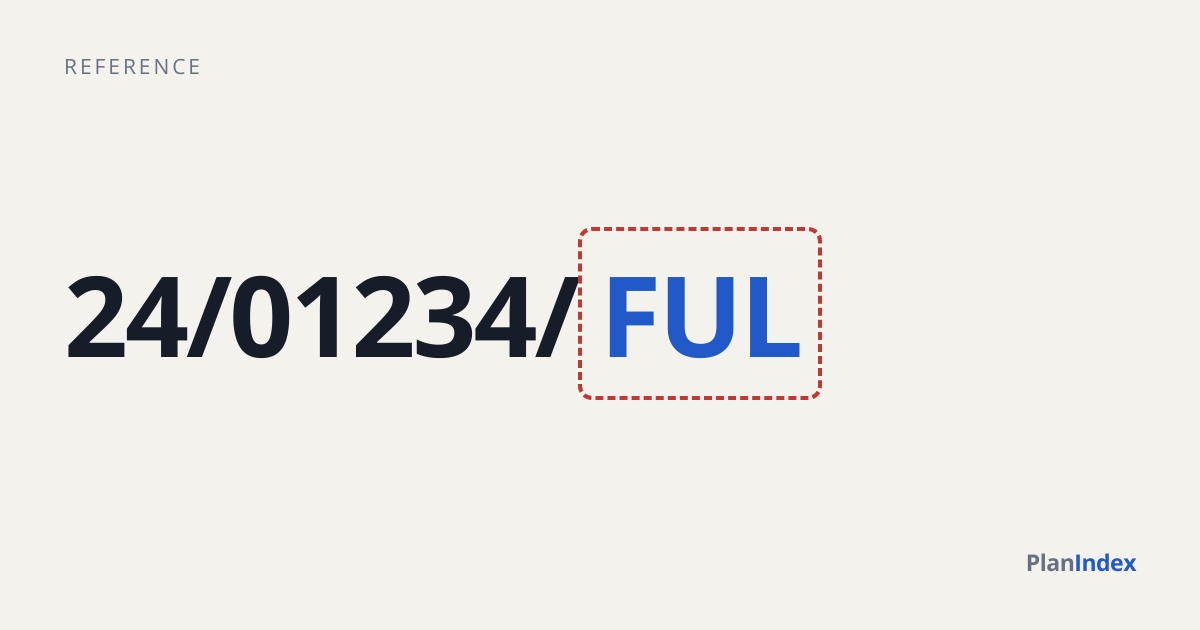
Most references follow a pattern of year, number, and a short code. Something like 24/01234/FUL reads as the 1,234th application logged in 2024, of the type FUL. Some councils lead with a letter block for the authority, so you also see forms like DC/24/01234 or P/2024/1234. London boroughs often use a plain year and number with a single trailing letter, for example 2024/1234/P.
There is no national standard, so the exact layout depends on the council and the software it runs. What stays consistent is that the reference is unique within that council, which is why a search for the number alone is often not enough. Pair it with the council name.
What the letters at the end mean
The code at the end tells you the type of application. The common ones are worth recognising:
FULorFULL: a full planning application, the standard route for most development.HHorHSE: a householder application, for extensions and works to a single home.OUT: outline, testing the principle of development before the detail is settled.REM: reserved matters, the detail that follows an outline approval.LBC: listed building consent, for work to a listed building.TPOorTCA: works to protected trees, or to trees in a conservation area.ADV: advertisement consent, for signs.PAorPD: prior approval, used for certain permitted development that still needs the council to sign off specific points.NMA: a non material amendment, a small change to an approved scheme.
Codes vary between councils, and some use their own, but these cover most of what you will meet. The type matters because it tells you what the council is actually deciding, and how much scope there is to comment.
Reading real references
A few genuine references from published registers show how much the pattern moves between councils while staying readable:
25/04095/FUL(City of Edinburgh): two digit year, case number, type. FUL here means an application for full planning permission.2016/0035/T(Camden): four digit year and a single trailing letter, T for tree works. London boroughs often keep the type code down to one or two letters.2026/0489/01/ADV(Newcastle upon Tyne): four blocks, with a sub number between the case and the type. The extra block distinguishes linked submissions on the same case file.LA04/2026/0179/F(Belfast): Northern Ireland references start with the council's own code. LA04 is Belfast City Council; the trailing F means full.25/0660(Newport): some councils use no type code at all, just year and number, and record the type separately in the register.
Scotland and Northern Ireland also use codes you will not meet in England. Scottish registers use DPP for detailed planning permission and PPP for planning permission in principle, the Scottish equivalent of outline, along with notification codes such as PNO. Northern Ireland's LA prefixes date from the 2015 transfer of planning to the new councils, so older cases there carry different department references.
One site, several references
A single project often generates a family of references, and it pays to check for siblings. A shop refit in a conservation area can need a full application and a separate advertisement consent; work to a listed building runs a listed building consent alongside the planning application; and once something is approved, the discharge of conditions arrives under its own reference, such as Leeds' 25/07080/COND. Councils usually cross reference these on the case file, so if the application you are reading seems to cover only part of the work you can see on site, search the address as well as the reference.
Resubmissions behave the same way. A refused scheme that comes back amended gets a fresh reference, typically the next year's sequence, and the old file stays on the register with its refusal. Comparing the two descriptions is often the quickest way to see what changed.
When a search comes up empty
References are written inconsistently even by the councils that issue them, so a failed search is usually a formatting problem rather than a missing record. Try these before assuming the application does not exist:
- Swap the separators.
24/01234/FUL,24-01234-FULand24.01234.FULare the same reference; portals differ in which they accept. PlanIndex search treats them alike. - Check the leading zeros. Case 35 of 2016 appears as
0035in Camden's format; typing 35 misses it on some systems. - Try both year forms. Councils switch between two and four digit years over time, and a letter about an old case may quote either.
- Confirm the council. Neighbouring authorities use near identical formats, and a letter from a county council about the same site may carry a county reference for minerals, waste or highways matters rather than the district's number.
References at appeal
If a refusal goes to appeal, the case picks up a second reference from the inspectorate, in England formatted like APP/X5210/W/24/3341234, where the middle block identifies the council area. Appeal documents quote both numbers, and the council register links the two, so either will find the case. In Scotland, reviews of delegated decisions go first to the council's own local review body under its reference before any national appeal.
Finding the application
Once you have the reference and the council, you can look the application up. Each application on PlanIndex has its own page showing the description, address, dates and decision, and a link to the council portal for the full documents. Start from the list of councils, open the one named on your letter, and find the reference in its recent applications, or search for the reference and the council name together.
If you are waiting on the outcome, it helps to know the timetable. Our guide on how long a planning decision takes walks through the targets and what tends to happen in practice. If you want to hear about new applications near you without checking by hand, you can set up an alert.