
Guide
What a planning condition means
Permission is rarely a plain yes. Almost every grant arrives with numbered conditions, and some must be discharged before a spade goes in the ground. What they require, what discharging one costs and what those applications reveal about a site near you.
By PlanIndex, published · last reviewed · 7 min read
The short answer
- Almost every planning permission in England is granted subject to conditions, printed and numbered on the decision notice with a short reason for each.
- A pre-commencement condition must be formally discharged before any work starts. Building first can leave the whole development without a lawful permission.
- Discharging conditions is a separate application with its own fee, currently £89 per request on a householder permission in England and £309 otherwise, and it appears on the public register under its own reference.
- The council has eight weeks to decide a discharge application, and for many condition types the applicant can force the issue through deemed discharge if no answer comes.
- A run of discharge applications on an approved site is the clearest public signal that construction is about to begin.
Permission has been granted, and underneath that word on the decision notice sits a numbered list. Or an application near you has just been approved and you want to know what the approval actually allows. Either way, the conditions are where the answer lives. They decide what can be built, when work can start and how the finished development has to behave, and they are read far less often than they should be.
Where conditions come from
Section 70 of the Town and Country Planning Act 1990 lets a council grant permission subject to conditions. That discretion is bounded by six tests in national policy: a condition must be necessary, relevant to planning, relevant to the development being permitted, enforceable, precise and reasonable in all other respects. A condition that fails one of those tests can be challenged, which is covered further down.
Two conditions appear on almost every grant. The first is the time limit: development must begin within three years of the date of the permission, which is the default set by section 91 of the Act. What counts as beginning, and what does not, is covered in the guide to what happens after a grant. The second ties the development to the approved drawings, and it is what makes building something different from the plans enforceable. Everything after those two is specific to the site. Materials to be agreed before work starts, obscure glazing to a side window, the hours a business can operate, a landscaping scheme to be planted in the first season after completion.
Each condition carries a short stated reason. Reading the reasons is the fastest way to see what the council was actually worried about, and if you objected, whether your objection landed; the officer's report gives the reasoning behind each one. An objection that does not stop a scheme often shapes its conditions instead, which is one of the outcomes covered in how objections are weighed.
Pre-commencement, pre-occupation and compliance
Conditions sort into three groups by when they bite, and the first group is the one that catches people out.
| Condition type | When it bites | Typical subject |
|---|---|---|
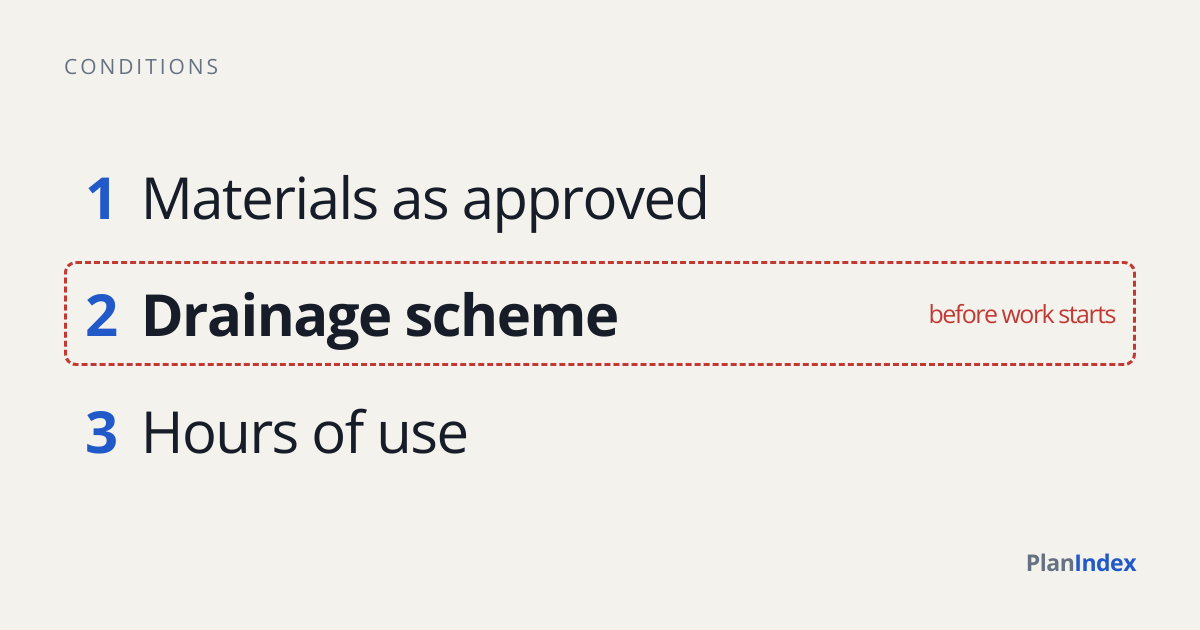
| Pre-commencement | Before any work starts | Drainage scheme, materials samples, construction management plan, archaeology |
| Pre-occupation | Before the building is used or lived in | Parking laid out, landscaping planted, boundary treatment installed |
| Compliance | For the life of the development | Hours of use, external lighting, keeping a use within a stated class |
One compliance condition is worth looking for on any newer house or conversion: a condition removing permitted development rights. Where one applies, an extension or outbuilding that a neighbour could build without asking needs a planning application here, and nothing about the house itself tells you so. The guide to what you can build without planning permission covers the other ways those rights disappear.
A pre-commencement condition must be formally discharged before development begins. Starting early is not a technicality: work carried out in breach of it may not count as a lawful start, which can leave the site without an implemented permission and surfaces years later when the property is sold and a buyer's solicitor asks for the discharge decisions.
Since October 2018 a council in England cannot impose a pre-commencement condition on a full application without the applicant's written agreement to its terms, under section 100ZA of the Act. Applicants get a chance to negotiate the worst ones out before the decision is issued, which is considerably easier than discharging them afterwards.
Discharging a condition: cost and timing
Where a condition requires details to be approved, the developer submits them as a formal application, usually titled approval of details reserved by condition. It gets its own reference and appears on the council's register like any other application. The format of that reference varies by council, and the shape of a reference number explains how to read whichever version yours uses.
In England the fee is £89 per request on a householder permission and £309 per request for anything else, as of April 2026. One request can cover several conditions on the same permission, so grouping them saves money. Regulations now before Parliament raise those figures to £125 and £435 for applications made on or after 8 December 2026.
The council has eight weeks to decide, or longer if agreed in writing, the same shape of deadline that applies to most planning decisions. If no decision comes, the applicant can use deemed discharge under section 74A: serve a notice on the council, and if it still does not respond by the date in the notice, the condition is treated as discharged. Some categories of condition are excluded from that route, so silence is not always an answer.
There is no requirement to publicise a discharge application or notify neighbours, and most councils decide them without doing either. The register is the only place they reliably surface.
What discharge applications reveal about a site
For anyone watching a site rather than building on it, discharge applications are the tell. A permission can sit dormant for two years and then produce three approval of details applications in a fortnight: drainage, materials, construction traffic. That flurry means the developer is spending money on consultants and intends to start, and it is public weeks or months before anything happens on the ground. The application types guide covers how these appear alongside the other application types on a register.
Because councils do not notify anyone about them, the only way to see them without checking the register on a schedule is to have the register checked for you. An alert on your area picks up discharge applications along with everything else, which turns the quietest application type into the most useful early warning. For a trade, that warning is a lead, and how to get leads from planning applications covers when to act on one and how to make contact.
Changing or challenging a condition
An applicant unhappy with a condition has two routes. A section 73 application asks the council to vary or remove it, and if that is refused the original permission is untouched, which is why it is usually tried first. A section 78 appeal against the condition goes to the Planning Inspectorate instead and must be made within six months of the decision, or twelve weeks for a householder application, and it puts the whole permission back on the table: an inspector can revisit more than the disputed condition.
Neighbours have neither route. There is no third party appeal against a condition, or against the decision it is attached to. What a neighbour can do is report a breach. A development operating outside its hours condition or built in the wrong materials can be reported to the council's enforcement team, which can serve a breach of condition notice with no right of appeal against it. Whether the council acts is another matter, covered honestly in what happens after a planning decision: enforcement is discretionary, teams are stretched and minor breaches are routinely left alone. A breach of condition that goes unchallenged for ten years becomes immune from enforcement altogether, at which point the owner can apply for a certificate of lawfulness to prove it.
Where this guide stops
The fees and deadlines above are England's. Wales and Scotland run their own fee schedules and procedures, and the differences are set out in the guides to finding applications in Wales and in Scotland. A condition is also not the same thing as a Section 106 agreement, which is a separate legal obligation negotiated alongside a permission rather than printed on the decision notice, and deserves its own guide.
If a site near you has permission, the decision notice, its conditions and any discharge applications are all on the register. Find the council's applications, read the conditions rather than just the decision, and set an alert so the applications that signal a start on site come to you.
Sources
Where the facts above come from
Common questions
Can work start before a pre-commencement condition is discharged?
No. A pre-commencement condition must be formally discharged by the council before development begins. Work carried out first may not count as a lawful start on the permission, which can leave the development without a valid consent and typically surfaces when the property is sold and the buyer's solicitor asks for the discharge decisions.
How much does it cost to discharge a planning condition?
In England, £89 per request on a householder permission and £309 per request for any other permission, as of April 2026. One request can cover several conditions on the same permission. Regulations before Parliament raise the fees to £125 and £435 for applications made on or after 8 December 2026. Wales and Scotland set their own fees.
Do neighbours get told about a discharge of conditions application?
No. There is no statutory requirement to publicise an approval of details application or to notify neighbours, and most councils decide them without doing either. They appear on the council's public register under their own reference, so checking the register, or having an alert check it for you, is the only reliable way to see them.
What happens if the council does not decide a discharge application in eight weeks?
The applicant can use the deemed discharge procedure under section 74A of the Town and Country Planning Act 1990: serve a notice on the council, and if no decision arrives by the date in the notice the condition is treated as discharged. Some categories of condition are excluded from deemed discharge, so for those the applicant must wait for an actual decision or appeal against non-determination.