
Guide
What to do if a neighbour builds without planning permission
No letter came, and something is going up next door. How to check whether it needed permission, how to report it, what the council does with a report, the notices it can serve, and how long an appeal can hold them up.
By PlanIndex, published · last reviewed · 14 min read
The short answer
- Building without planning permission is not a criminal offence in itself in England. It becomes one when the owner fails to comply with an enforcement notice; works to listed buildings and protected trees are the main exceptions.
- Suspected breaches are reported to the council's planning enforcement team. Enforcement is discretionary: the council acts only where it is expedient, and a neighbour cannot force it to act or appeal a decision not to.
- The most common outcome is a retrospective planning application, which goes on the public register and can be objected to like any other. In PlanIndex open data on 1 November 2026, 2.7% of applications (3,594 of 132,848) described the work as retrospective.
- An owner can appeal an enforcement notice before it takes effect, and the notice has no effect while the appeal runs. Enforcement appeals in England took a median of 66.4 weeks to decide in the year to September 2026, against 16.1 weeks for planning appeals.
- In England, building work completed on or after 25 April 2024 becomes immune from enforcement after ten years. Work completed before that date had four.
Something is going up next door and no letter came. It might be an extension deeper than anything you have seen approved, a garden building tall enough to see into your kitchen, or a build that has drifted from the plans you commented on. This covers what to check before reporting it, what the council does with a report, the notices it can serve, how long each stage takes, and what is left to you if the council does nothing. The rules are England's unless the text says otherwise; the other nations are near the end.
Check whether it needed permission
A great deal of building work never needs a planning application, and nothing requires an owner building under permitted development to tell the neighbours first, so the absence of a letter proves nothing. Search the address on the council's register for an approval, a prior approval or a certificate of lawfulness, then compare what you can see with the limits. If it is next door and there was no letter sets out those checks, with the measurements that decide most extension cases.
Some problems that feel like planning breaches belong to someone else. Planning enforcement deals with what is built and how land is used, not with how safely it is built or where the boundary runs.
| What you have noticed | Who deals with it |
|---|---|
| An extension, outbuilding or change of use with nothing on the register | The council's planning enforcement team |
| Work departing from approved plans, or ignoring a condition such as obscure glazing or working hours | The council's planning enforcement team |
| Structural safety, fire safety, drainage or insulation | Building control: the council's team, or the private approver on the job |
| Work on or next to a shared wall | The Party Wall etc. Act 1996, a civil matter between owners |
| Where the boundary runs, a right of way or a covenant | A civil matter for a solicitor, not the council |
| Noise or dust from the build itself | Environmental health, unless a planning condition limits working hours |
What counts as a breach
A breach of planning control is development carried out without the permission it needed, or a failure to comply with a condition or limitation on a permission. Going beyond permitted development limits counts, because the work then has no permission at all rather than most of one.
None of that is a criminal offence in itself. The offences attach to notices: building without permission becomes an offence when the owner fails to comply with a notice the council has served. The main exceptions are works to a listed building without consent, an offence whether or not a notice has been issued, and works to a protected tree, which the tree guide covers. Enforcement exists to put planning harm right, not to punish people for skipping a form, and a council can lawfully decide that a breach causing no harm needs no action.
Reporting it
Every council has a planning enforcement team, usually with an online reporting form. A report the team can act on gives:
- The address, and where on the site the work is: the rear garden, the side wall, the building by the back fence.
- What has been built, or what the land is now used for, in plain words.
- When work started and whether it is still going on. Dates matter more than anything else, because the time limits for action run from when work was substantially completed.
- Dated photographs, taken from your own property or a public place. Do not go onto the site.
- The reference of any permission you think is being breached, and the condition or drawing it departs from. Reading a reference number helps you find the right case.
Then say what harm the work causes, in the terms an objection would use: the window it overlooks, the light it takes, the comings and goings of a new use. Whether action is worth taking turns on planning harm, judged against the same considerations listed in what the council can weigh.
A report is not an objection. Objections are published on an application's record with your name; enforcement complaints are not on the planning register at all. Councils generally ask for your contact details and say in their enforcement policy how they handle them, and some will not investigate an anonymous report. If you are worried about the owner learning who complained, read the policy first and say so in the report.
What the council does next
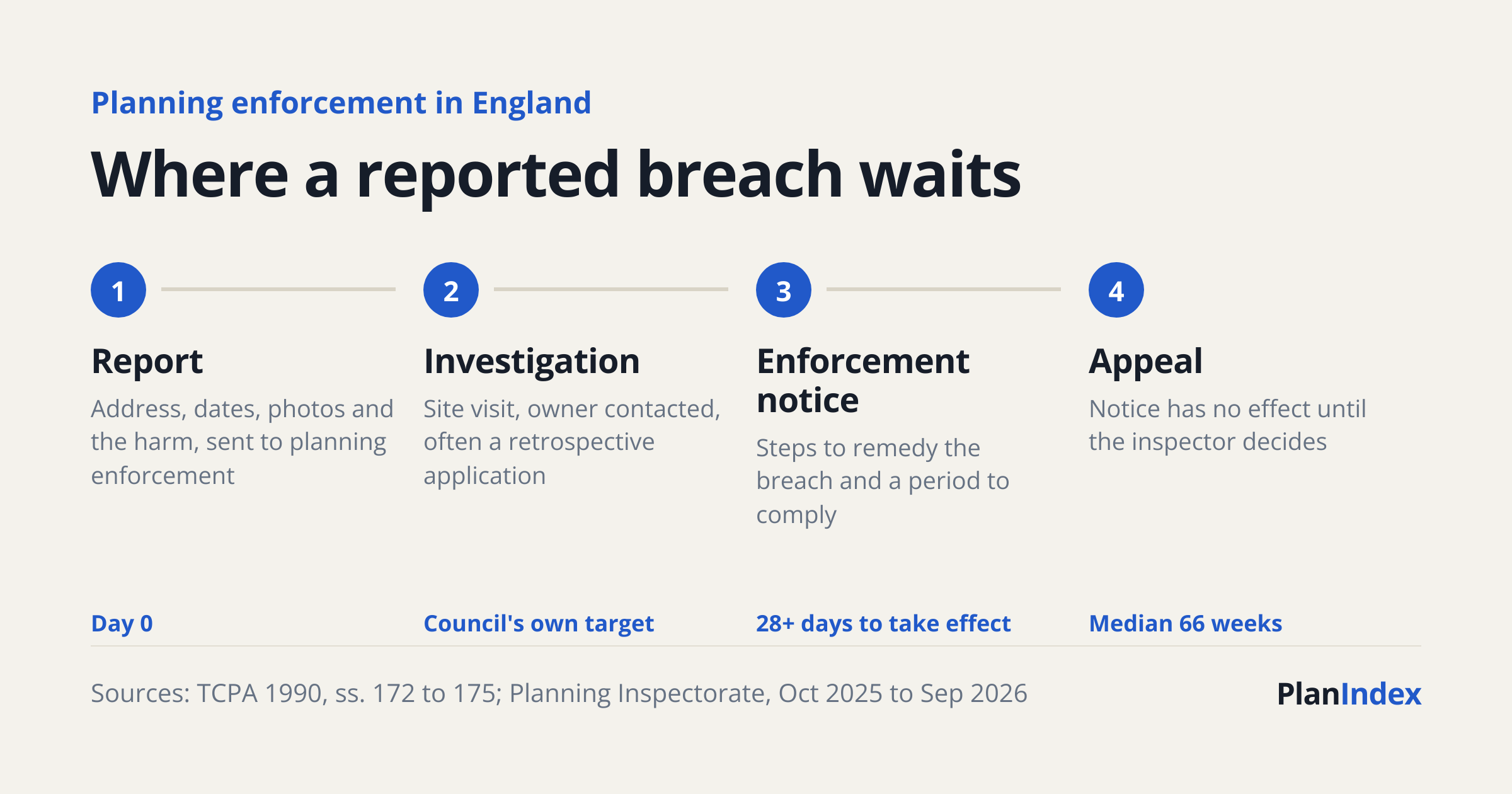
The council first establishes the facts, usually through a site visit and contact with the owner, which government guidance treats as the first step. It then asks two questions. Is there a breach? And if so, is it expedient to act, having regard to the development plan and any other material considerations?
Expediency is the word to understand. The test is not whether a rule was broken but whether the breach causes harm that action would put right. Government guidance says councils should usually avoid formal action where a breach is trivial or technical and causes no material harm, or where the development would be acceptable on its merits anyway. National policy calls enforcement discretionary and asks councils to respond proportionately.
That leaves three outcomes. The council can close the case. It can invite the owner to apply for permission after the event, so the work is judged on its merits. Or it can take formal action, which means serving a notice. Where the facts are unclear it can first serve a planning contravention notice demanding information, which must be answered within 21 days; failing to reply, or replying falsely, is an offence.
How fast this happens is set locally. National policy asks councils to consider publishing a local enforcement plan, and those that do set out how they rank cases and how quickly they aim to visit a site. Search the council's name with "local enforcement plan" to find its targets.
Sources: Town and Country Planning Act 1990, sections 172 to 175; Planning Inspectorate statistics, October 2025 to September 2026
Retrospective applications
The usual response to a breach that might be acceptable is a request for a retrospective application under section 73A of the Town and Country Planning Act 1990. Since 25 April 2024 a council in England can make that request formally with an enforcement warning notice, which sets a deadline for the application, goes on the public enforcement register and carries no right of appeal. If the deadline passes, formal action can follow.
The application is decided in the normal way, on its planning merits, and government guidance says the council must not assume it will be granted. For a neighbour this is the moment that counts. It goes on the register under its own reference with the usual publicity, and you can comment with the same planning points as any objection, describing what is actually there rather than what a drawing proposes. Writing an objection covers the shape of a comment that gets weighed.
These applications are routine. In PlanIndex's open data on 1 November 2026, which holds every application first seen in the previous 30 days across 335 councils, 3,594 of 132,848 proposals (2.7%) describe the work as retrospective, at 294 of those councils. Extensions and changes of use each account for close to a fifth, followed by boundary walls, fences and gates, then garden outbuildings. The true share is higher, because many councils call the same thing the retention of works.
If the application is refused, the council can serve an enforcement notice, and once a notice is issued it can decline to determine a fresh application for the same development, which stops an owner reapplying to buy time.
The notices a council can serve
| Notice | What it does | Appeal | If it is ignored |
|---|---|---|---|
| Enforcement warning notice | Sets a deadline for a retrospective application | None | Formal action can follow |
| Planning contravention notice | Requires information about the land and its use within 21 days | None | Offence |
| Enforcement notice | Sets out the breach, the steps to remedy it and a period to comply; takes effect at least 28 days after service | To the Planning Inspectorate, before it takes effect | Offence with an unlimited fine; the council can also do the work and recover the cost |
| Breach of condition notice | Requires compliance with a condition on an existing permission | None to the Inspectorate; judicial review only | Offence with an unlimited fine |
| Stop notice | Halts an activity while an enforcement notice runs its course; takes effect 3 to 28 days after service | None to the Inspectorate | Offence with an unlimited fine |
| Temporary stop notice | Halts an activity at once for up to 56 days, with no enforcement notice needed | None to the Inspectorate | Offence with an unlimited fine |
| Injunction | A court order, sought as a last resort | Through the courts | Contempt of court, which can mean prison |
The breach of condition notice fits the problems neighbours typically raise after a grant, such as a build running outside its permitted hours or a side window meant to be obscure glazed. Because there is no appeal to the Inspectorate, it cannot be parked for a year the way an enforcement notice can.
Enforcement warning notices, enforcement notices, stop notices and breach of condition notices all go on a register the council must keep open to the public. To find out whether action has been taken on a site, ask to see it.
If the owner appeals
Only someone who owns, rents or lawfully occupies the land can appeal an enforcement notice, and the appeal must reach the Planning Inspectorate before the notice takes effect. Once an appeal is made, the notice has no effect until it is decided or withdrawn. That suspension is what makes enforcement slow.
The owner can argue that permission ought to be granted (ground (a)), that the breach did not happen or is not a breach, that it is too late to act, that the notice was not properly served, or that the steps or the time allowed go too far. Since 25 April 2024 ground (a) is unavailable in England where the notice was issued after a related planning application was made, unless more than two years have passed since that application was dealt with. An owner whose retrospective application has just been refused cannot use the appeal to have the merits judged twice.
Neighbours have a part in it. The council has to tell occupiers nearby that an appeal has been made, anyone can comment to the Inspectorate, and the start letter for an appeal gives interested people six weeks from the start date. Enforcement appeals carry a C in their Inspectorate reference, as in APP/C3430/C/24/3350826 at South Staffordshire; references at appeal explains the rest of the format.
Then comes the wait. The Planning Inspectorate decided 2,978 enforcement appeals in the year to September 2026, with a median of 66.4 weeks from a valid appeal to a decision. Planning appeals took a median of 16.1 weeks over the same period. On that median, an enforcement appeal lodged at the end of 2026 would be decided in the spring of 2028. The inspector can uphold the notice, vary it, quash it or grant permission for what was built.
Two appeals on one register
In July 2025 Wakefield issued an enforcement notice on a house in Horbury alleging three things done without planning permission: a retaining wall, engineering works that changed the levels of the rear garden, and an access road. The appeal is on the register as 25/01619/ENFAPP, received on 22 August 2025, and the register records the outcome on 9 March 2026: notice upheld. A second appeal, 25/01422/ENFAPP in Stanley, did not argue for permission at all. It ran on grounds (c) and (f), that the matters were not a breach and that the steps went too far, was received on 23 July 2025, and ended with the notice upheld on 12 May 2026.
Measured from the dates on the council's register, those took about 28 and 42 weeks, well inside the national median. They also show why searching by address beats searching by code. Wakefield labels enforcement appeals ENFAPP; other councils use ENF or file them alongside ordinary applications. Both cases are among Wakefield's applications on PlanIndex under the council's own references.
If the council decides not to act
There is no third party appeal against a decision not to enforce, any more than against a grant of permission. Ask for the decision and the reasons in writing; government guidance expects councils to record decisions to take no further action. Raise it with your ward councillor, who can put questions to officers that you cannot. Then use the council's complaints procedure and, after that, the Local Government and Social Care Ombudsman. The Ombudsman looks at whether the council went wrong in how it handled the case, such as never visiting the site, not at whether it made the right call. Complain to the council first, and to the Ombudsman within 12 months of realising something went wrong. It cannot make a council knock a building down.
Keep your dated photographs and notes either way. If the owner later applies for a certificate of lawfulness claiming the work is too old to enforce against, they are evidence, and what a neighbour can do about a certificate application explains how to submit them.
Time is the other thing to watch. In England, building work substantially completed on or after 25 April 2024 becomes immune from enforcement after ten years, as does a change of use to a single home; work completed before that date had four. A breach of condition has ten years. The time limits table covers every nation, and deliberate concealment can take a case outside the limits altogether.
Scotland, Wales and Northern Ireland
Wales runs the same 1990 Act with its own amendments: Welsh councils can issue enforcement warning notices under section 173ZA, failing to comply with a breach of condition notice carries a fine of up to level 3 on the standard scale (currently £1,000) rather than an unlimited one, appeals go to Planning and Environment Decisions Wales, and building work still becomes immune after four years. In Scotland, under the Town and Country Planning (Scotland) Act 1997, every planning authority must publish an enforcement charter setting out its policies, how to report a breach and how complaints are handled, so read that first; appeals go to the Planning and Environmental Appeals Division and the four and ten year limits still apply. In Northern Ireland the district councils enforce under the Planning Act (Northern Ireland) 2011, appeals go to the Planning Appeals Commission and the limit is five years. Complaints about a council's handling go to the public services ombudsman for each nation.
Where this guide stops
None of this is legal advice. Works to a listed building or a protected tree are criminal matters with their own procedures, touched on in the application types guide and the tree guide. Building regulations are a separate regime: approval under one is not approval under the other. If the work damages your property or stands on your side of the boundary, that is a civil claim against the owner, and no planning decision settles it.
Keeping track
A retrospective application is the one point in an enforcement case where a neighbour has a formal say, and it comes with the same 21 day comment window as any other application. Applications to discharge conditions and changes to an approved scheme, which show whether a build is about to depart from what was granted, arrive with no letter at all. Set up an alert for your street and both reach you by email while there is still time to respond.
Sources
Where the facts above come from
Common questions
Is it illegal to build without planning permission?
Not in itself. Carrying out development without the permission it needed is a breach of planning control, but in England it only becomes a criminal offence when the owner fails to comply with a notice the council has served, such as an enforcement notice or a breach of condition notice. Works to a listed building without consent are the main exception: they are an offence whether or not a notice has been served.
Will my neighbour find out I reported them?
Enforcement complaints are not published on the planning register the way objections are, and most councils set out in their enforcement policy how they handle a complainant's details. Some councils will not investigate an anonymous report, so read the policy before you report and say in the report if you are worried about being identified. Bear in mind that the owner may guess, especially if you are the only house that can see the work.
How long does the council have to take enforcement action?
In England, building work substantially completed on or after 25 April 2024, and a change of use to a single home made on or after that date, become immune from enforcement after ten years. Work completed before 25 April 2024 had four years, and other changes of use and breaches of condition have ten. Wales and Scotland still use four years for building work, and Northern Ireland uses five for everything.
Can the council make my neighbour knock it down?
Yes, if it decides that is expedient. An enforcement notice can require works to be removed and gives the owner a period to do it; if they do not, it is an offence carrying an unlimited fine and the council can do the work itself and recover the cost. The owner can appeal first, and while the appeal runs, which took a median of 66.4 weeks in England in the year to September 2026, the notice has no effect.
What can I do if the council refuses to take enforcement action?
There is no third party appeal against a decision not to enforce. Ask for the decision and reasons in writing, raise it with your ward councillor, then use the council's complaints procedure. If you think the council went wrong in how it handled the case, rather than simply reaching a decision you disagree with, you can then complain to the Local Government and Social Care Ombudsman in England, normally within 12 months.