
Guide
How to get leads from planning applications
The planning register shows building work before it starts. What each stage of an application tells a trade, how to judge a record from its description, who you can contact, and the rules on letters, emails and calls when you do.
By PlanIndex, published · 11 min read
The short answer
- Planning applications are published on the council's register before any work starts, with the address, the work proposed and every date, and anyone can read them.
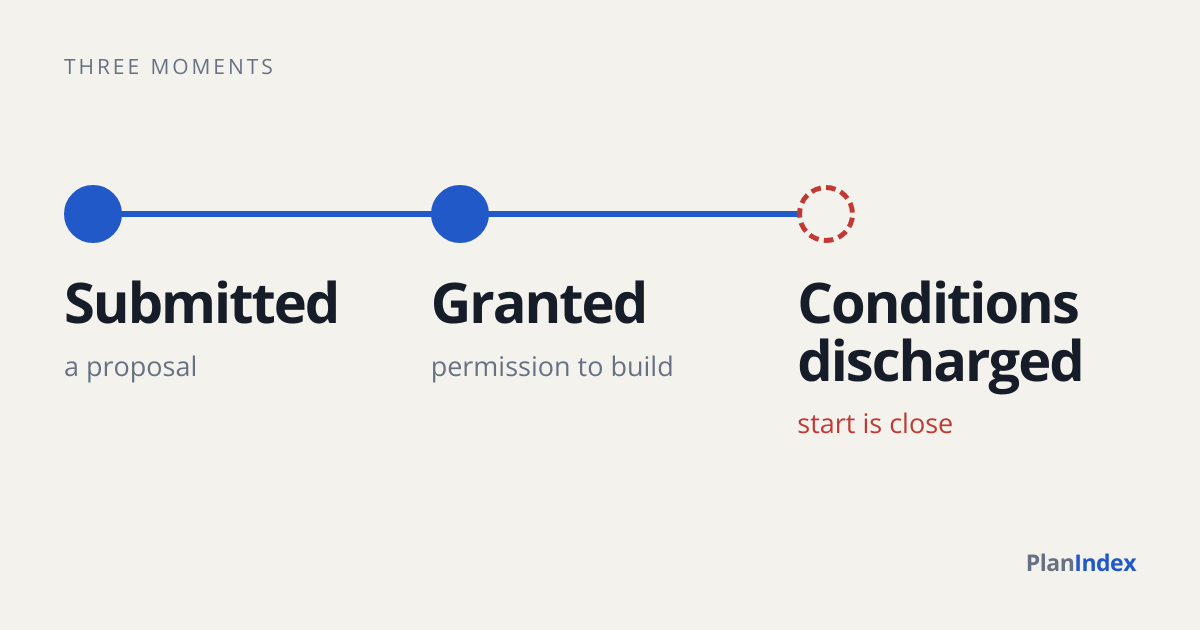
- Three moments matter to a trade: the application (a proposal that may be refused), the decision (in England, normally three years to start) and applications to discharge pre-start conditions, which show a start is being organised.
- Contacting someone about their application is direct marketing. Under PECR, marketing emails and texts to homeowners, sole traders and ordinary partnerships need prior consent, while limited companies and LLPs can be emailed without it if you identify yourself and offer an opt-out.
- Post is outside PECR but not outside UK GDPR. The ICO says removing a name does not stop marketing being directed at someone, so a letter prompted by one household's application should say who you are, where you saw it and how to opt out.
- The register does not show a budget, a start date or whether a builder is booked, and plain permitted development never appears on it.
An extension is drawn, applied for and decided in public, usually months before anyone digs a footing. The council's planning register shows the address, the work proposed in the applicant's own words and every date along the way, and anyone can read it. For a trade working a patch, that makes the register the first public sign of most work coming to a street. It is also a list of people who never asked to hear from you, and how you use it decides whether it brings in jobs or complaints.
Three moments on the register
An application changes state in public, and each state means something different to a trade.
Submitted. A new application is a proposal. Neighbours get at least 21 days to comment, the council has a target of eight weeks for most decisions, and the answer may be no. The drawings are on the council's portal from the first day, before anyone has permission to build. For most trades a new application is one to watch rather than act on. The exception is the agent named on it, covered below.
Decided. A grant is permission to build, and in England the work normally has to begin within three years under section 91 of the Town and Country Planning Act 1990. It is usually when an applicant without a builder starts looking for one, and the moment most building trades should act. A refusal matters too. The owner still wants the work and now needs better drawings or a stronger case, which makes refusals the useful records for architects and planning agents; what happens after a refusal covers resubmissions and appeals.
Clearing conditions. Most grants carry conditions, and some must be satisfied before any work begins: a drainage scheme, materials samples, a construction management plan. They are cleared by a further application under its own reference, and neighbours are not told about it. A run of these on an approved site is the clearest public sign that a start is close, and the planning conditions guide explains how to read them.
| On the register | What it tells you | Who it suits | How it reaches you on PlanIndex |
|---|---|---|---|
| New application | A proposal that may still be refused, with drawings on the council portal | Firms that already work with the agent | Daily digest, on every plan including free |
| Grant | Permission to build, normally with three years to start in England | Builders, roofers, loft specialists, kitchen and bathroom fitters | Decision alert, on the paid plans |
| Refusal or withdrawal | The owner still wants the work and needs a better scheme | Architects and planning agents | Decision alert, on the paid plans |
| Discharge of conditions | Pre-start details being cleared, so a start is being organised | Scaffolders, groundworkers, suppliers, landscapers | Daily digest, with a conditions filter on the paid plans |
| Proposed certificate of lawfulness, or prior approval | Work that needs no full application, checked before it is built | Loft conversion specialists, builders | Daily digest and decision alerts |
Reading a record before you treat it as a lead
The description is the applicant's own account of the work, and it is more specific than most people expect. "Single storey rear extension" is a building job with a roof and, usually, new glazing. "Two storey side extension and loft conversion with rear dormer" adds scaffolding and roofing, and often a bathroom. Replacement windows, render, solar panels, a dropped kerb and a new driveway all appear by name. PlanIndex tags each record with the kinds of work its description mentions, read from the words rather than estimated, and the drawings on the council's portal settle the scale.
Some records look like jobs and are not new ones. A variation of a condition, often made under section 73, or a non-material amendment changes a scheme that already has permission; it tells you the scheme is live, not that there is a second project. A resubmission repeats a refused scheme, so read the refusal first. And where the agent is itself a building firm, such as a design and build company, the builder was chosen before the application was made. The application types guide explains what each kind of record is deciding.
One Chichester site, start to finish
25/02012/FUL at Chichester is the kind of small job most local trades want. It covers a change of use to a single house, single storey rear extensions, replacement windows to the front and a new front boundary of railings on brick piers. The council received it on 26 August 2025, validated it on 4 September and granted it on 28 October, 54 days after validation and inside the eight week target. Neighbours had until 8 October to comment.
The decision notice carries seven conditions. Condition 3 says no development may start, demolition included, until a construction and environmental management plan has been approved, covering vehicles, contractors' parking, hoarding, dust and noise. A condition like that puts the start of a build on the public record before it happens.
Nothing further was lodged against the permission for almost six months. On 21 April 2026 an application to discharge condition 3 arrived under its own reference, 26/00913/DOC, and the council approved it on 8 June. The same architecture practice is named as agent on both applications. The permission runs until 28 October 2028.
Read as a lead, the record offered three moments. A builder after the main contract wanted the grant in October, when the applicant had permission and, unless a builder was already lined up, a choice to make. A scaffolder or a supplier wanted the April application, because a construction plan means a start is being organised. The railings, the front windows and the fitting out sit later in any build, so for those trades even June was early. And the agent named on both applications was the contact most likely to outlast this one job.
Who is named on a record, and who you can contact
Three parties appear on a typical record, and they are not equally reachable.
The agent is the architect, architectural technician or planning consultant who prepared and lodged the application. Agents are named on the register as businesses, they lodge application after application in the same area, and the agent is often the person an owner asks for a builder's name. A working relationship with one busy agent is worth more than any single lead. Every application page on PlanIndex shows the agent and applicant companies where the register names them, and the Trade plan shows everything a firm has filed and how it was decided.
The applicant may be a company: a developer, a landlord, a business extending its premises. Contacting one is business to business.
On a householder application the applicant is a private person. PlanIndex never shows their name or contact details, on any plan. The council's own record may name them, as Chichester's does in the example above, but a name on a public register is not permission to market to it, and the rules below apply in full. For a homeowner the practical route is a letter to the site address.
The rules on letters, emails and calls
Two sets of rules apply. The Privacy and Electronic Communications Regulations 2003, known as PECR, govern marketing calls, emails and texts. UK GDPR and the Data Protection Act 2018 govern any use of personal information, including the address a letter goes to. Offering your services to someone because of their application is direct marketing under both, because it is advertising directed at a particular person.
| Channel | Homeowner, sole trader or ordinary partnership | Limited company, LLP or Scottish partnership |
|---|---|---|
| Letter | No consent needed, but it is direct marketing under UK GDPR | No consent needed |
| Email or text | Only with their prior consent | Allowed without consent, if you say who you are and give a working opt-out |
| Phone call | Only to a number not registered with the Telephone Preference Service, and never after they object | Only to a number not registered with the Corporate Telephone Preference Service, and never after they object |
Letters. Post is outside PECR, which makes a letter the straightforward route to a homeowner. It is not outside data protection law, and addressing the envelope to the occupier does not change that. The ICO's guidance is that removing someone's name does not stop marketing being directed at them, and a letter sent because of one household's application is aimed at that household. In practice that means four things: say who you are, with a business name and address; say where you saw the application, on the public planning register, quoting the reference; give a simple way to opt out; and keep a list of every address that does, so it never hears from you again. The right to object to direct marketing is absolute. The ICO also advises checking named mailings against the Mailing Preference Service, which some industry codes require and the law does not.
Email and text. Homeowners, sole traders and ordinary partnerships are individual subscribers under PECR, and unsolicited marketing emails or texts to them need consent you will not have. Finding an address on a website does not change that; the ICO is explicit that publicly available contact details are not consent. Limited companies, LLPs and Scottish partnerships are corporate subscribers and can be emailed without consent, provided the message says who it is from and offers a working way to unsubscribe. A small practice may be a sole trader or a partnership rather than a company, so check Companies House before emailing one, and remember that an address belonging to a named person is still personal information.
Calls. A live marketing call can go to a number that is not registered with the TPS, or the CTPS for a company, and whose owner has not already told you they do not want calls. Screen every number. If you do not hold a number already, do not go looking for one: the ICO says obtaining extra contact details from other sources is likely to be unfair in most cases.
Whatever the channel, make it obvious the contact comes from a business. A letter that could be mistaken for council correspondence invites a complaint.
Where this guide stops
The register records intentions, not contracts. It does not show a budget, a start date or whether a builder has been booked, and a grant is not a promise: permissions lapse, people move and quotes come back too high. Plain permitted development never reaches the register, so an extension built without an application is invisible to every alert, this one included. What you can build without planning permission explains why.
Large schemes are bought differently. Developments of ten or more homes tend to be built by main contractors with their own supply chains, and if that is your market, the researched services described in our Glenigan comparison track projects past planning into procurement, which an alert does not.
The rules section summarises ICO guidance on UK GDPR and PECR as it stood in October 2026. The ICO is revising its guidance as the Data (Use and Access) Act 2025 comes into force, so check the current version before running a campaign. None of this is legal advice.
PlanIndex covers the councils it covers, and the council list shows which, with live counts.
Watching a patch without checking by hand
Checking a council portal by hand works for one council and a few streets. Past that, an alert does the checking: pick a postcode and a radius, and new applications arrive as one email a day, with nothing sent on a quiet day. Watching one area is free and shows what your postcode actually produces. The Trade plan adds five areas up to five miles, category and keyword filters, an alert when a decision is picked up from the register, work-starting-soon alerts, and the agent and applicant companies behind each scheme. The trade pages cover what to watch for each kind of work, and pricing sets the plans side by side.
Sources
Where the facts above come from
Common questions
Is it legal to contact someone about their planning application?
Yes, within limits. A letter to the property needs no consent, but it counts as direct marketing under UK GDPR, so it should say who you are, where you saw the application and how to opt out, and an opt-out must be honoured. Marketing emails and texts to a homeowner need their prior consent under PECR, and marketing calls can only go to numbers not registered with the Telephone Preference Service.
Can I email the architect or agent named on a planning application?
If the practice is a limited company or LLP, yes. PECR allows unsolicited marketing email to corporate subscribers without consent, provided you identify yourself and give a working way to opt out. A sole trader or ordinary partnership is an individual subscriber, so a cold email needs consent; write or phone instead, and check Companies House to see which kind of business a practice is.
Does PlanIndex show homeowners' names or phone numbers?
No. PlanIndex shows company names and professional agents where the register names them, and never a private applicant's name or contact details, on any plan. The council's own record may include a name, but if you use it for marketing the data protection rules apply in full, including telling the person where you got their details.
When should a trade get in touch about a planning application?
It depends where your work falls in a build. Builders usually act on the grant, when permission is in hand and a builder may still be needed. Scaffolders, groundworkers and suppliers do better waiting for applications to discharge pre-start conditions, which show a start is being organised, and finishing trades can wait longer still. Architects and planning agents look for refusals, where the owner still wants the work done.