
Guide
How long a planning decision takes
The statutory targets, what actually happens in practice, and how to read the dates on an application to see where it is in the process.
By PlanIndex, published · last reviewed · 5 min read
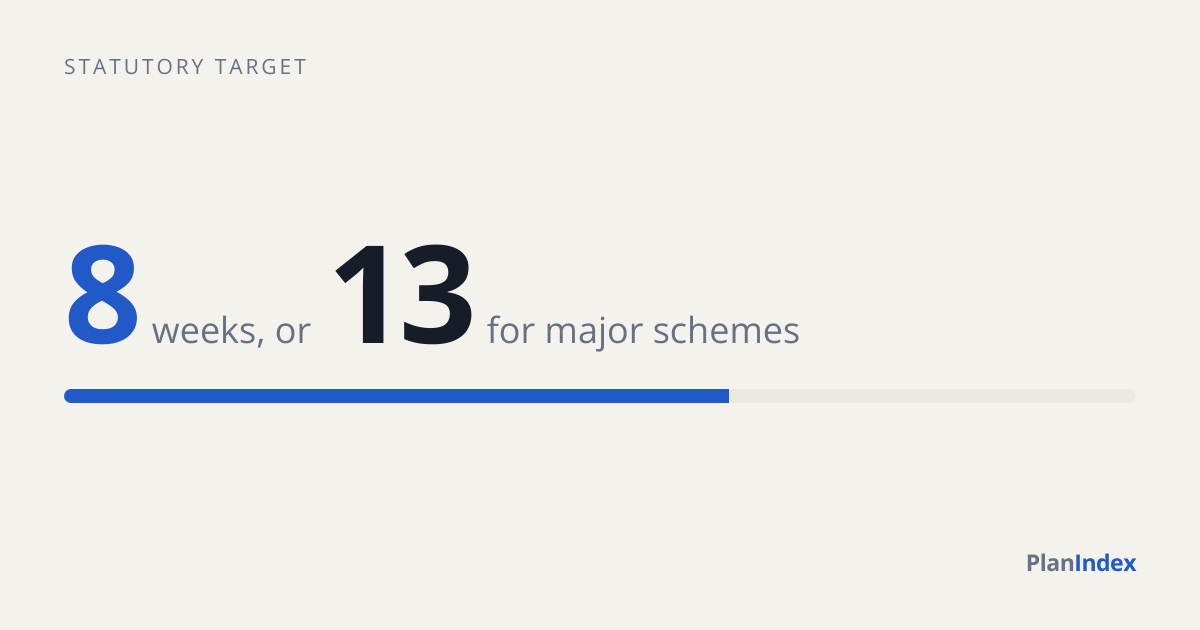
Planning has formal targets for how quickly councils should decide applications. They are useful to know, but the target and the reality often differ, and the dates on an application tell you more than the target alone.
The statutory targets
For most applications, including householder work and other minor development, the council is expected to decide within eight weeks of validating the application. For major development, such as ten or more homes or larger commercial schemes, the target is thirteen weeks. Where an application needs a full environmental impact assessment, the period is sixteen weeks.
Prior approval cases run to their own, shorter deadlines. Several types must be determined within a fixed number of days, and if the council does not respond in time the approval can be automatic. That makes the dates on a prior approval application worth watching closely.
Why cases run longer
The eight week clock is a target, not a guarantee, and a large share of applications take longer. Rather than refuse an application to beat the deadline, a council will often agree an extension of time with the applicant. Consultation responses, revised drawings, and the wait for a committee slot all add time. A scheme that draws objections or needs changes can easily run to several months.
None of that means an application is in trouble. A long running case is usually one being worked on, not one being ignored.
What decided cases actually show
The registers PlanIndex indexed in July 2026 put real numbers on the gap between target and practice, and on how much it varies by council. Across the year of decisions to July 2026 where both dates are published: Manchester decided at a median of 55 days, with 69% of cases inside eight weeks. Cornwall, one of the largest caseloads in the country at nearly 7,000 decisions, managed a median of 49 days and 82% inside eight weeks. The City of Edinburgh was quicker still at a 26 day median.
Belfast shows the other end of the range: a median of 94 days, with roughly a quarter of decisions inside eight weeks. Northern Ireland's longer timescales are well documented, and they are a good example of why the local figures matter more than the national target. Every council hub on this site carries the same measures for that authority, worked out from its own decided cases, so check the hub for the council handling your application before you set expectations.
The fixed deadline exceptions
Prior approval cases are the main exception to the flexible clock. Larger home extensions under permitted development must be determined within 42 days; most other prior approval classes, including many telecoms cases, run to 56 days. In several of these classes the work may lawfully proceed if the council fails to respond in time, so the deadline has real teeth. If you want to object to a prior approval case, do it early: a late consultation response to a deemed consent is a response to a decision already made.
If no decision ever comes
An applicant is not stuck waiting forever. Once the statutory period and any agreed extension has passed, they can appeal against non-determination, which moves the case to the inspectorate as though it had been refused. It is used sparingly because it removes the council's ability to negotiate, but it exists precisely because some cases stall.
In England there is also the planning guarantee: if a council takes more than 26 weeks to decide an application and no extension of time was agreed, the application fee must be refunded. Very large schemes often sidestep all of this with a planning performance agreement, a paid arrangement that sets a bespoke timetable up front.
What actually moves a case along
For applicants, most delay is avoidable at the start: applications rejected as invalid, then resubmitted, lose weeks before the clock even starts, so matching the council's validation checklist matters more than anything that happens later. Once a case is live, the common causes of drift are outstanding consultee responses, requests for revised drawings, and waiting for a committee date where the case cannot be decided by officers. Responding to an officer's request quickly, and completely, is usually the difference between an eight week case and a sixteen week one.
Reading the dates
An application usually carries a few dates. The received date is when the council first got it. The validated date is when the council confirmed it was complete, and this is when the statutory clock starts, so it is the one to measure from. The decision date, once it appears, is when the outcome was issued.
On PlanIndex these dates sit on each application page as a plain timeline, so you can see where a case has got to. Council hub pages also show a typical decision time for that authority, worked out from applications it has actually decided, which is a better guide to what to expect locally than the national target.
If you are not sure how to find a particular application, our guide on reference numbers explains how. To keep track of an area without checking by hand, you can set up an alert, or browse applications by council.